

EVENTS

Academician Colloquium: Science and China — A Thousand Academicians, A Thousand Science Talks 科學與中國 —— 千名院士 · 千場科普
Digital Interactive Lab (DIL), 2/F, Main Library, HKU
Abstract Free Electron Laser Technology and its Applications in Science 自由電子激光技術的發展及其科學應用 Speaker: Prof. Xueming Yang Chair Professor, Southern University of Science and Technology Distinguished Fellow, Dalian Institute of Chemical Physics, CAS Since the advent of the first laser in the 1960s, we have witnessed a magnificent growth of laser technologies, which had revolutionary impacts on modern science and industrial technology. It is extremely difficult to generate VUV to X-ray lasers using regular laser media. In the last two decades or so, free electron laser based on modern accelerator science has become a new frontier in this area, expanding laser science and technology into the VUV and X-ray region. Here, I will briefly introduce the history of free-electron laser technology and its applications in physics, chemistry, and biology etc. The talk will also review the progress made in the free electron laser development in China in the last few decades and its future potential application as a tool in scientific research and frontier technology development. Superconducting Detectors and Terahertz Astronomy 超導探測器與太赫茲天文 Speaker: Prof. Sheng-Cai Shi Professor, Purple Mountain Observatory (PMO), CAS Chair, PMO Advisory Committee Superconductivity has long been known to enable highly sensitive photon detectors, yet superconducting detector technologies matured only in the late 20th century. The terahertz band lies between microwave and optical/infrared regimes, with its photon energies comparable to the superconducting energy gap. Driven by advances in superconducting detection technologies, terahertz astronomy has witnessed rapid growth in recent years, including the capture of the first black hole image in human history. This talk presents the latest progress in superconducting detectors and terahertz astronomy, together with China’s terahertz astronomy programs from space to the Qinghai-Xizang Plateau to Antarctica. For enquiries, please contact science@hku.hk.
READ MORE
HKU Science Distinguished Lecture Series: Treatment of Acute Promyelocytic Leukemia with All-trans Retinoic Acid and Arsenic Trioxide: A Model of Cancer Synergistic Targeted Therapy
CPD-1.21, Run Run Shaw Tower, Centennial Campus, HKU
Lecture Overview Once one of the most fatal forms of blood cancer, acute promyelocytic leukaemia (APL) has become one of the most curable, thanks to pioneering advances in targeted therapy. Professor Zhu Chen's groundbreaking work combining all-trans retinoic acid (ATRA) and arsenic trioxide has transformed APL treatment, offering a powerful model of how synergistic targeted therapies can improve cancer outcomes. For enquiries, please contact science@hku.hk.
READ MORE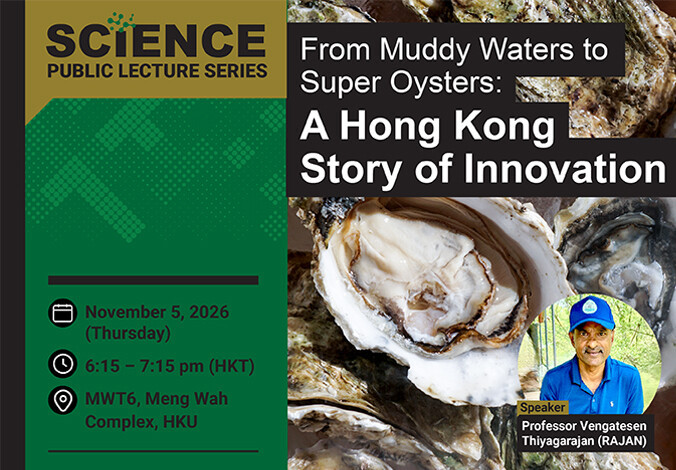
Science Public Lecture Series: From Muddy Waters to Super Oysters: A Hong Kong Story of Innovation
MWT6, 1/F, Meng Wah Complex, Main Campus, HKU
Abstract For centuries, Hong Kong’s native oyster, an endemic and historically important species, has been farmed as a tasty, nutritious white-meat delicacy in the muddy waters of Deep Bay and along the South China coast. This century, our Hong Kong oysters have tolerated rapid industrial growth along coastal areas and associated coastal habitat changes, including climate change, pollution and eutrophication, but at the huge expense of their deserved economic value. Our collaboration with growers and industry produced a major breakthrough: a multiple stress-resilient and climate-change-tolerant super strain, HKU's Super Oyster. Today, growers have started earning more and looking forward to year-round harvests in salty coastal waters, thanks to a non-reproductive triploid oyster. In response, government and industry have joined forces to chart a sustainable farming path amid climate change. Come witness "HKU's Super Oyster", a climate-crushing, carbon-sucking, heritage-saving local delicacy, born in Deep Bay and bred by HKU scientists. For enquiries, please contact science@hku.hk.
READ MORE


