EVENTS
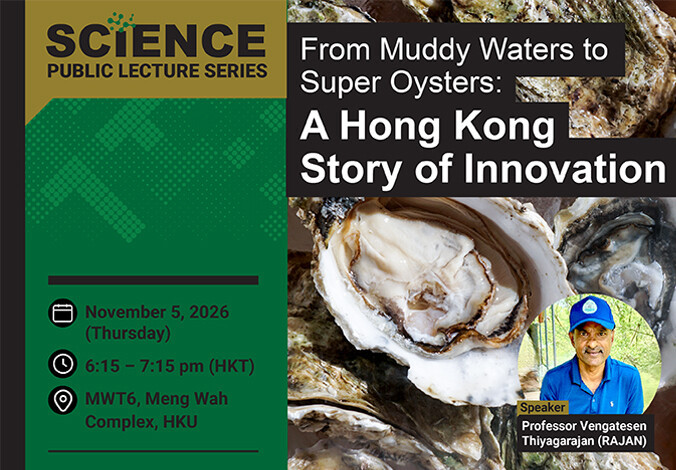
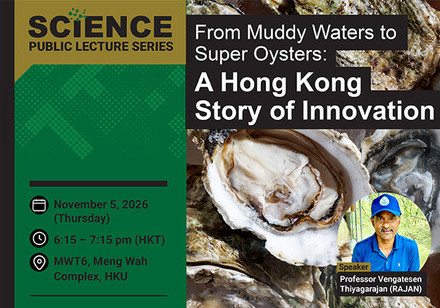
Science Public Lecture Series: From Muddy Waters to Super Oysters: A Hong Kong Story of Innovation
MWT6, 1/F, Meng Wah Complex, Main Campus, HKU
Abstract For centuries, Hong Kong’s native oyster, an endemic and historically important species, has been farmed as a tasty, nutritious white-meat delicacy in the muddy waters of Deep Bay and along the South China coast. This century, our Hong Kong oysters have tolerated rapid industrial growth along coastal areas and associated coastal habitat changes, including climate change, pollution and eutrophication, but at the huge expense of their deserved economic value. Our collaboration with growers and industry produced a major breakthrough: a multiple stress-resilient and climate-change-tolerant super strain, HKU's Super Oyster. Today, growers have started earning more and looking forward to year-round harvests in salty coastal waters, thanks to a non-reproductive triploid oyster. In response, government and industry have joined forces to chart a sustainable farming path amid climate change. Come witness "HKU's Super Oyster", a climate-crushing, carbon-sucking, heritage-saving local delicacy, born in Deep Bay and bred by HKU scientists. For enquiries, please contact science@hku.hk.
READ MORE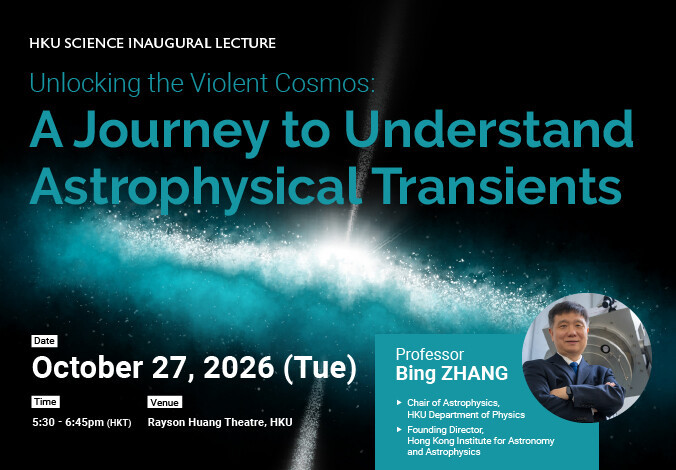
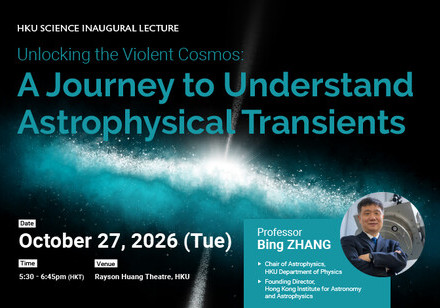
HKU Science Inaugural Lecture Series: Unlocking the Violent Cosmos: A Journey to Understand Astrophysical Transients
Rayson Huang Theatre, HKU
Abstract The night sky appears peaceful, but our universe is filled with fireworks created by various astrophysical transients that light up all wavelengths—and even non-electromagnetic channels such as gravitational waves and neutrinos. This lecture introduces humanity’s journey to understand two mysterious transient phenomena, known as gamma-ray bursts and fast radio bursts, highlighting observational breakthroughs and theoretical insights that help solve these cosmic puzzles, both from a historical perspective and through the lens of the speaker’s research career. For enquiries, please contact science@hku.hk.
READ MORE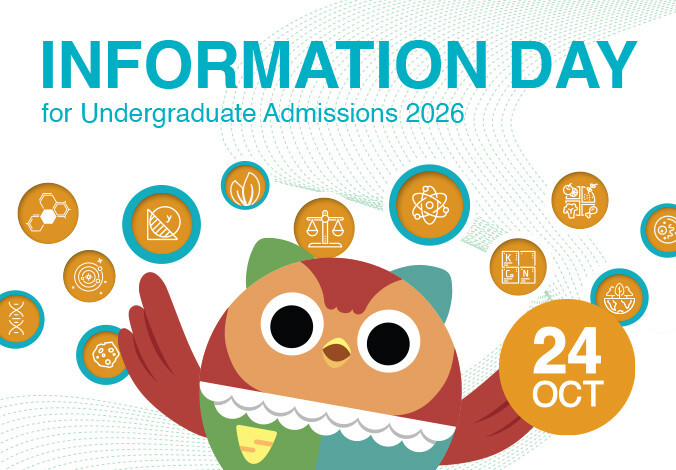
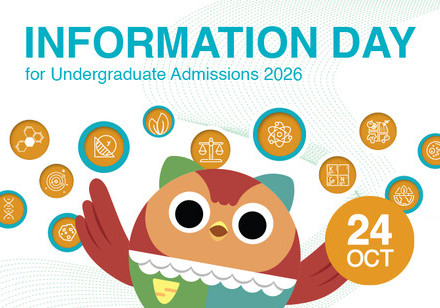
Information Day for Undergraduate Admissions @HKU Science 2026
Yuet Ming Fountain Area, outside Chong Yuet Ming Chemistry Building & Run Run Shaw Podium
The HKU Information Day for Undergraduate Admissions 2026 will be held on October 24 (Saturday). On Information Day, five departments/school in the Faculty of Science — the School of Biological Sciences, Departments of Chemistry, Earth and Planetary Sciences, Mathematics, Physics, and the School of Biomedical Sciences from the Li Ka Shing Faculty of Medicine, will take this opportunity to introduce the new initiatives in our Science curricula, our academic programmes and learning experiences offered to prospective students and the public. Information booths for each of our Science majors and programmes, such as Science Master Class, Bachelor of Science and Bachelor of Laws, as well as a game booth to test your science knowledge and let you know more about our programmes in a fun way, will be set up at the Yuet Ming Fountain Area. Don't forget to stop by our Faculty Information booth at Run Run Shaw Podium to learn what we have offered. Come and visit us on October 24. All are welcome! Admission Talks on Science Programmes and Majors View talk schedule Exhibitions, Guided Tours to laboratories and other departmental facilities View activity schedule Visit to HKU Transportation
READ MORE