

03 Mar 2026
How Birds Thrive on Sugar
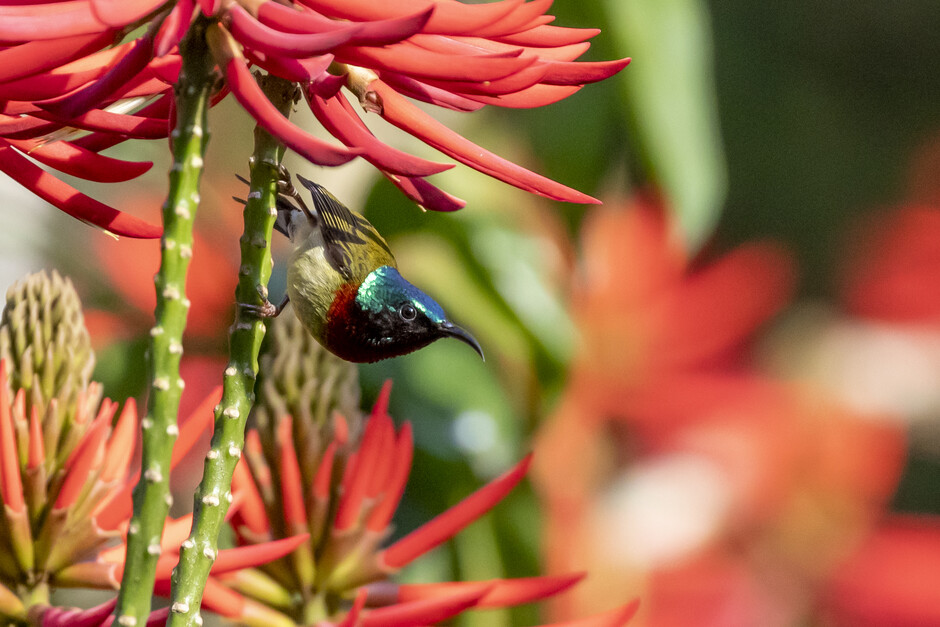
Fork-tailed sunbird drawing nectar from coral tree blossoms. Image provided by Ivan Lam.
Most birds avoid sugary food. But hummingbirds, sunbirds, honeyeaters and some parrots live almost entirely on nectar or fruit to fuel their high-energy lifestyles. They consume huge amounts of sugar every day, without developing diabetes or other diseases that high-sugar diets can cause in humans.
How do they do it?
An international team, including Professor Simon Sin of the School of Biological Sciences, compared the genomes of four bird groups that independently evolved sugar-rich diets with the genomes of closely related birds that do not eat sugar. Even though these sugar-consuming birds evolved on different continents and millions of years apart, the scientists found something striking: evolution had affected some of the same genes in each group.
Some genetic changes were unique to each lineage. But others appeared again and again, especially in genes involved in sugar processing and in regulating blood pressure and fluid balance. These changes help birds handle both the high sugar levels and the large volumes of liquid they consume from nectar.
 | .jpg) | 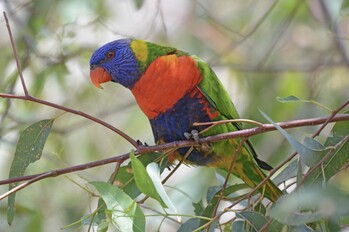 |
Hummingbird feeding on nectar, engineered by evolution for extreme energy demands. Image provided by Simon Sin. | New Holland honeyeater in feeding posture. Image provided by Gerald Allen. | Rainbow lorikeet perched among leafy branches. Image provided by Gerald Allen |
Out of thousands of genes examined, one stood out. A gene called MLXIPL, which plays a key role in sugar metabolism, was modified in all four sugar-eating bird groups but not in their non-sugar-eating relatives. Laboratory tests showed that in hummingbirds, this gene is much more active than in close relatives that do not feed on nectar.
The findings suggest that evolution can arrive at similar biological solutions, even in species separated by millions of years. Understanding how these birds tolerate extreme sugar intake may also offer clues for studying human metabolic diseases.
The research was led by scientists at Harvard University, the Max Planck Institute for Biological Intelligence, and the Senckenberg Research Institute and Natural History Museum Frankfurt. Professor Simon Sin contributed to sequencing and assembling the whole genomes of several sugar-feeding bird species.
The study "Convergent and lineage-specific genomic changes shape adaptations in sugar-consuming birds" is published in Science and can be accessed here.
You may also be interested in

07 Sep 2026

07 Sep 2026
28 Aug 2026
21 Aug 2026
02 Aug 2026
29 Jul 2026