

23 Mar 2026
HKU Team Explores Ancient Pathogens in Antarctica

Nesting gentoo penguins (Pygoscelis papua) on Ardley Island. Image credit: Alexander Williams.
HKU researchers have returned from Antarctica after collecting sediment samples from penguin colonies to trace ancient pathogens and understand how environmental change shapes microbial ecosystems.
The fieldwork brings together researchers from across HKU, including the School of Biological Sciences (SBS), and is led by the School of Public Health (SPH), with collaborators from the University of Nottingham. By analysing DNA preserved in layers of sediment rich in penguin guano, the team aims to reconstruct past microbial communities and identify potential pathogens associated with penguin populations.
Collecting Clues from Antarctic Lake Sediments
Fieldwork was carried out on King George Island and Ardley Island in Antarctica as part of the PathoPast project, led by Dr Alexander Williams (Postdoctoral Fellow, SPH), with contributions from Dr Martha Ledger (Postdoctoral Fellow, SBS) and Dr Roseanna Mayfield (Assistant Professor, the University of Nottingham).
The team collected sediment cores from Antarctic lakes located near historic penguin colonies. These layered sediments act as natural archives, preserving biological material deposited over decades to centuries, including large quantities of penguin droppings, or “guano”. By analysing ancient nucleic acids preserved within the guano-rich sediments, the project aims to reconstruct past microbial communities and identify potential pathogenic organisms associated with penguin populations.
Although Antarctica is often perceived as pristine and isolated, it is experiencing rapid environmental change. Shifts in temperature, wildlife distribution and human activity may influence microbial dynamics in ways that are not yet fully understood.
“Sediment cores allow us to look back in time,” said Dr Williams. “By analysing the microbial traces preserved in lake sediments, we can reconstruct how they have fluctuated over time in response to environmental change. This helps us understand not only wildlife health in polar ecosystems, but also broader One Health dynamics, including how environmental shifts influence pathogen circulation across wildlife, ecosystems and potentially even human interfaces.”
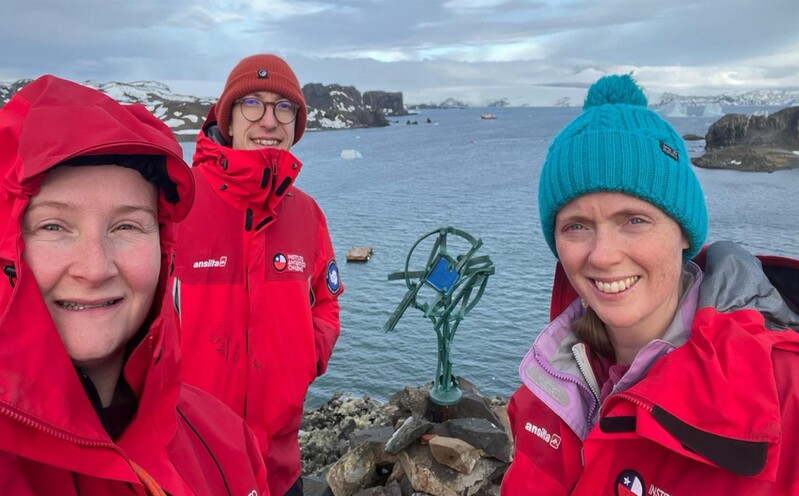
PathoPast field team in Antarctica (from left): Drs Martha Ledger, Alexander Williams and Roseanna Mayfield. Image credit: Martha Ledger.
Fieldwork Under Extreme Conditions
Fieldwork was conducted on Ardley Island and King George Island under challenging logistical and environmental conditions. The team carried specialised coring equipment and an inflatable dinghy, weighing a combined 70kg, across difficult terrain in cold, highly variable weather conditions, working within tight operational windows.
“Antarctic fieldwork requires careful planning and resilience,” Dr Ledger added. “Weather conditions can change rapidly, and every sediment core extracted requires coordinated teamwork. But being able to recover these intact sediment records from such a remote environment is incredibly rewarding.”
In addition to sediment cores, the team collected modern penguin guano samples to assess present-day microbial communities. These samples will be analysed at the HKU State Key Laboratory of Emerging Infectious Diseases and compared with the historical records preserved in the lake sediments.
Antarctic research access is highly internationally competitive. The project benefited from transnational access to the Professor Julio Escudero Base, funded by the European Union’s Horizon Europe programme through the POLARIN project (Grant Agreement No. 101130949).
At HKU, the project is conducted under the supervision of Professor Tommy Lam from SPH, with support from The Hong Kong Jockey Club Global Health Institute (HKJCGHI), which contributes to its conceptual design, laboratory work and data analysis.
You may also be interested in
28 Aug 2026
21 Aug 2026
02 Aug 2026
29 Jul 2026
30 Jun 2026

24 Jun 2026