

30 Jun 2026
HKU Marine Scientists Reveal Hong Kong’s “Secret Fish” Thriving in Murky Waters
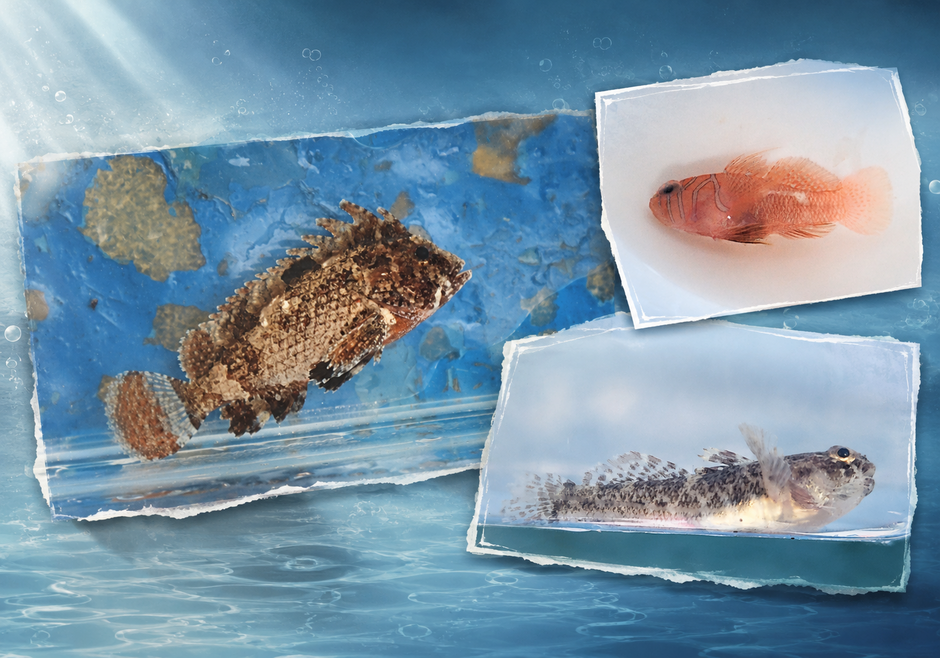
The word “crypto”, used as a prefix in “cryptocurrency”, comes from Greek kryptos, meaning “secret” or “hidden”. “Benthic” refers to life at the bottom of a body of water. The two combine perfectly in “cryptobenthic fish” , “secret fish that live close to the seabed”.
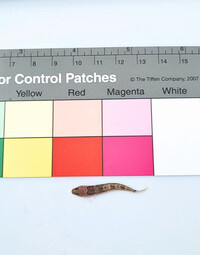
Measuring about the length of two matchsticks, cryptobenthic fish spend much of their lives hiding in the nooks and crannies of the sea floor. Even when they venture into the open, many are almost impossible to spot because of their natural camouflage. Despite being common in coastal waters, they have remained largely overlooked by scientists, and much about them is still unknown.
Now, thanks to the efforts by Maxine Curtacci, we know much more about the “secret fish” of Hong Kong. Originally from Italy, Maxine is a PhD student in Professor Celia Schunter’s lab at the Swire Institute of Marine Science (SWIMS), HKU School of Biological Sciences.
Over the past three years, Maxine has collected cryptobenthic fish and fragments of their DNA across Hong Kong. She has found 60 different species – more than the number recorded on some pristine coral reefs of Indonesia and Australia.
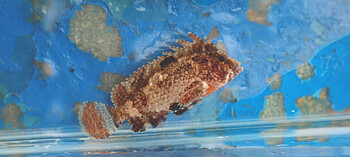
Paracentropogon rubripinnis. Commonly known as waspfishes, fish in this genus are often venomous, with poison glands on their spines. |
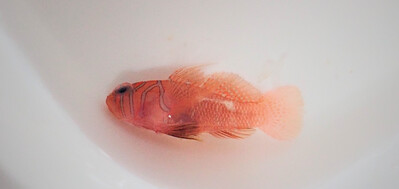
Priolepis semidoliata.Half-barred goby. This brightly coloured species lives on coral reefs. |
Priolepis semidoliata. Half-barred goby. This brightly coloured species lives on coral reefs. |
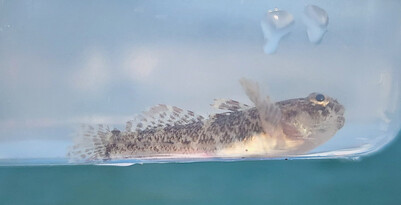
Bathygobius hongkongensis. Hong Kong frill-goby. This species, even though very common, was described as late as 1986. |
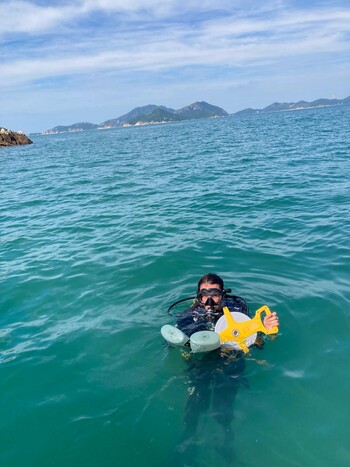
Finding these “secret fish” is no easy task. Maxine and her colleagues used scuba diving gear to place specially designed quadrats – rectangular plastic frames with a cloth sack attached to one end on the seabed. They then released clove oil into the quadrats, anaesthetising the fish and causing them to drift out of their hiding places and into the sack.
“Hong Kong’s waters are notoriously murky, partly due to the natural discharge of sediment from the Pearl River. The team often had to work in “visibility of less than one metre, where you cannot really see anything,” says Maxine.
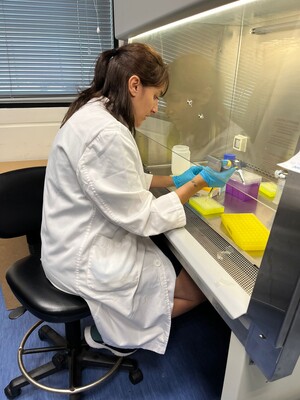
She supplemented the clove-oil-and-cloth-sack method with cutting-edge technology – environmental DNA (eDNA). Using eDNA, scientists do not need to find the actual fish. Instead, they can detect their presence from tiny fragments of genetic material the fish have shed into the water.
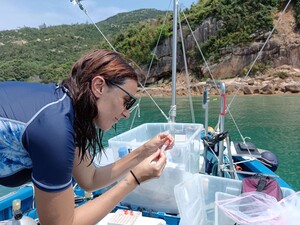
“eDNA allows us to see which species are present without collecting or harming the fish. All we needed to do was scoop around five litres of seawater at each location,” explains Maxine.
This simple sampling method proved remarkably powerful. In fact, eDNA was far more effective at detecting cryptobenthic fish than traditional physical sampling.
“We found 60 species of cryptobenthic fish in total, of which 57 we detected with eDNA and 17 we collected physically. Moreover, all but 3 of the 17 collected species were also found with eDNA,” says Maxine.
Maxine Curtacci holding a transect during a research dive to sample cryptobenthic fish in South Bay. Image credit: Lucrezia Bonzi |
Maxine Curtacci in the lab, preparing eDNA samples before sending them for sequencing. Image credit: Cheuk Ho Wu | Fieldwork in South Bay in Hong Kong. Maxine Curtacci holding the fish specimens collected during a dive. Image credit: Cheuk Ho Wai
|
Why spend three years diving in near-zero visibility to chase tiny fish that are so hard to find? "The small size of these fish belies their immense ecological importance,” explains Professor Schunter, the principal investigator who received a grant from the Marine Conservation Fund to study Hong Kong’s cryptobenthic fishes.
“They are the snack bowl of the sea,” explains Professor Schunter. “They feed on microscopic algae, plankton and invertebrates, converting them into fish biomass – in other words, into food that larger predators, and eventually humans, rely on for food. Scientists used to be baffled by how the teeming-with-life coral reefs survive in nutrient-poor tropical waters. Cryptobenthic fishes are the rapid-recycling engine that makes this possible.”
“Previous studies on cryptobenthic fish all focused on pristine environments, for example, coral reefs in Australia,” says Maxine. “Before us, no research had been done on them in a degraded marine environment, which is common in Hong Kong.”
Maxine examined how the combination and number of species of cryptobenthic fish varied across different pollution levels in Hong Kong. She sampled fish at six sites that formed a pollution gradient: Gold Coast, North Lantau, Discovery Bay, Cheung Sha Beach, South Bay and Tai Tam. Gold Coast was the most degraded site, with the highest levels of pollution.
The surprising finding was that the more degraded the site was and the higher the pollution, the more cryptobenthic fish it seemed to support – both in number and in species.
“We found the highest abundance of several species in the most degraded environment,” says Maxine. “In some non-degraded sites, we would find only five fish in a sample; in degraded sites, we could find as many as 50. One example is Tridentiger trigonocephalus, or chameleon goby, a common species in harbours around the world.”
Why are these fish thriving in places where many other marine organisms struggle? Maxine suggests that plentiful food may be one reason. “Many cryptobenthic fish feed on detritus – tiny particles of organic matter,” she said. “Degraded sites tend to have higher water turbidity, which means there may be more of these particles for the fish to eat.”
Understanding how cryptobenthic fish diversity is shaped by human activity can help scientists better assess the health of degraded, urbanised marine environments.
Assessing a healthy marine ecosystem is relatively straightforward: scientists can look for well-known indicator species whose presence suggests that the environment is in good condition. In a degraded ecosystem, however, many of these species may have disappeared. This makes it harder to understand what the smaller, lesser-known species that remain can tell us about the state of the local environment.
This is how Maxine imagines a future survey using “secret fish”: “First we use eDNA to determine which cryptobenthic fish species are present. Since we know the pollution tolerance of these species, their presence can give us a picture of the conditions of the site.”
“Our study shows that even in heavily urbanised coastal areas like Hong Kong, cryptobenthic fish populations can be rich and diverse,” concludes Professor Schunter. “These tiny, overlooked fishes are vital indicators of human impact on our coastal ecosystems. Understanding them better is key to protecting our oceans.”
You may also be interested in
07 Sep 2026

07 Sep 2026
28 Aug 2026

21 Aug 2026
02 Aug 2026

29 Jul 2026