

28 Aug 2026
Fossil Shark Scales Reveal How Ocean Productivity Shapes Shark Resilience
Why can shark populations withstand fishing pressure in one ocean, yet decline sharply in another just around 100 kilometres away?
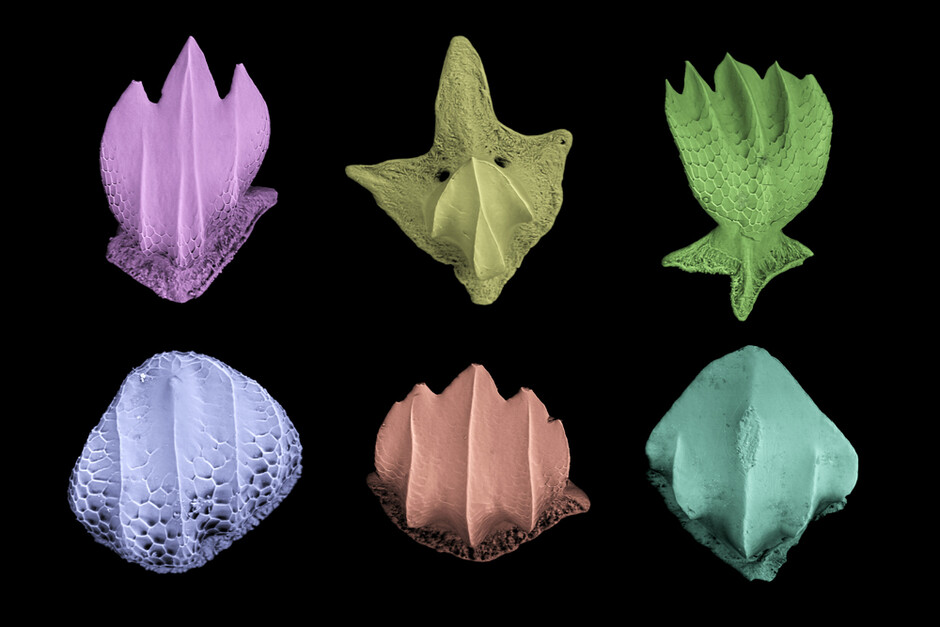
The researchers reconstructed thousands of years of shark history on the Pacific and Caribbean sides of the Isthmus of Panama using dermal denticles — tiny, tooth-like scales shed naturally by sharks and preserved in seafloor sediments. Because different types of sharks produce denticles with different forms, these microscopic fossils provide scientists with a record of past shark communities.
The method itself took more than a decade to build. “This project began 12 years ago with a wild idea to search for shark scales in reef sediments. Finding the first denticle was exhilarating,” said Dr. Erin Dillon (lead author) and collaborator of Dr. Cybulski at the Smithsonian Tropical Research Institute (STRI). “We had to work out what denticles could tell us, how to get them out of reef sediments and how to read a fossil assemblage. Panama represented the perfect place for applying the approach, because it let us compare shark baselines across two very different oceans separated by a single strip of land.”
The results revealed a striking natural difference between the two oceans. Even before significant human exploitation, the Pacific side supported around 20 times more sharks than the Caribbean side, despite their geographical proximity and similarities in shark communities.
Their responses to human pressure were also very different. Shark abundance in the Caribbean declined by around 75%, while no comparable decline was detected on the Pacific side even though it experienced >95% of the historical fishing pressure.
The researchers attribute this contrast largely to differences in ocean productivity. Nutrient-rich Pacific waters support greater primary productivity and higher fish biomass, providing more food for sharks and potentially buffering their populations against fishing pressure. The less productive Caribbean naturally supports lower shark biomass, making its populations more vulnerable to additional human impacts.
“This study shows the difference that environmental factors can play in controlling biomass in our oceans,” said Dr Cybulski. “In the Caribbean, with less nutrients and overall productivity, we have less shark biomass at the top of the food chain. Conversely, in the nutrient-rich Pacific with higher primary productivity, we have greater shark biomass through time.”
During his postdoctoral research in Panama at STRI, following his PhD at HKU, Dr. Cybulski was involved in collecting reef-matrix cores from which Pacific shark denticles were recovered, and subsequently participated in the analysis and interpretation of the data.
The findings are not, however, a clean bill of health for Pacific sharks. “Our samples from the recent time point are not capturing the whole story for modern shark populations, because our sampling methods averaged several hundreds of years’ worth of data,” said Dr. Cybulski. “We know that fishing in the Gulf of Panama, and globally, has increased in the last several decades. As a result of increased fishing effort, nearly 1/3 of all sharks and rays are now critically threatened. Additionally, human-induced climate change is altering known ocean productivity processes, such as upwelling in the Gulf of Panama. So, although we found the sharks in the Pacific may have a high capacity to recover, modern impacts from fishing and climate change may push them to a limit they have never experienced."
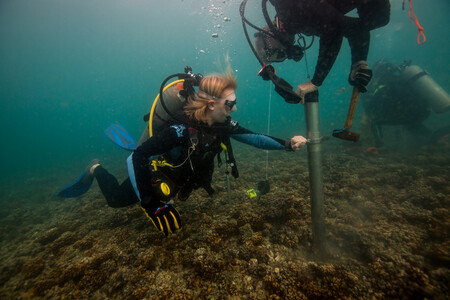
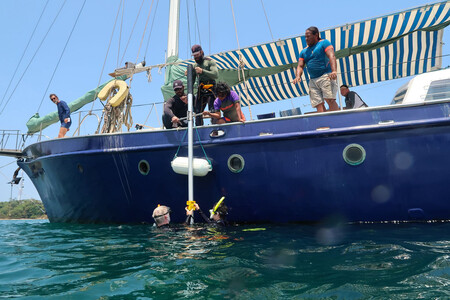
Dr. Erin Dillon and team collecting a coral reef matrix core in the Gulf of Panama, Tropical Eastern Pacific. |
Variation in dermal denticle morphology. Denticles were imaged using a scanning electron microscope and false coloring applied. |
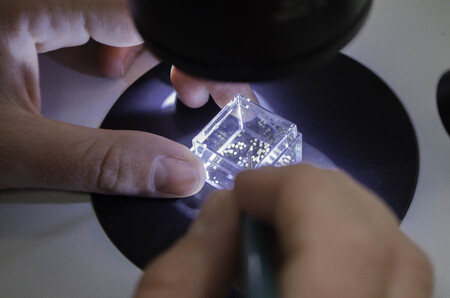
Observing shark dermal denticles under a microscope. |
Dr. Cybulski and team hammering in a coral reef matrix core in the Gulf of Panama, Tropical Eastern Pacific. |
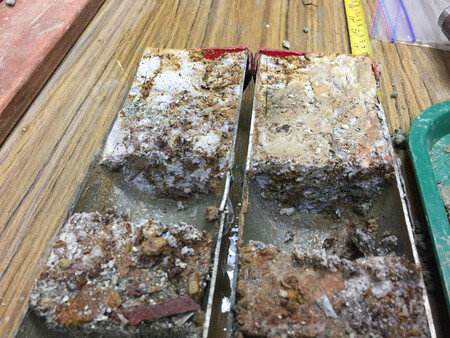
Sub-sampling a coral reef matrix core for further processing. |
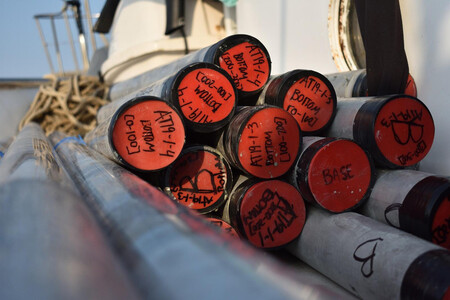
Coral reef matrix cores from a research expedition in the Gulf of Panama, Tropical Eastern Pacific. |
You may also be interested in
21 Aug 2026
02 Aug 2026

29 Jul 2026
30 Jun 2026

24 Jun 2026

21 Jun 2026