

12 May 2026
HKU Science Joins China’s First Mars Sample Return Mission Tianwen-3
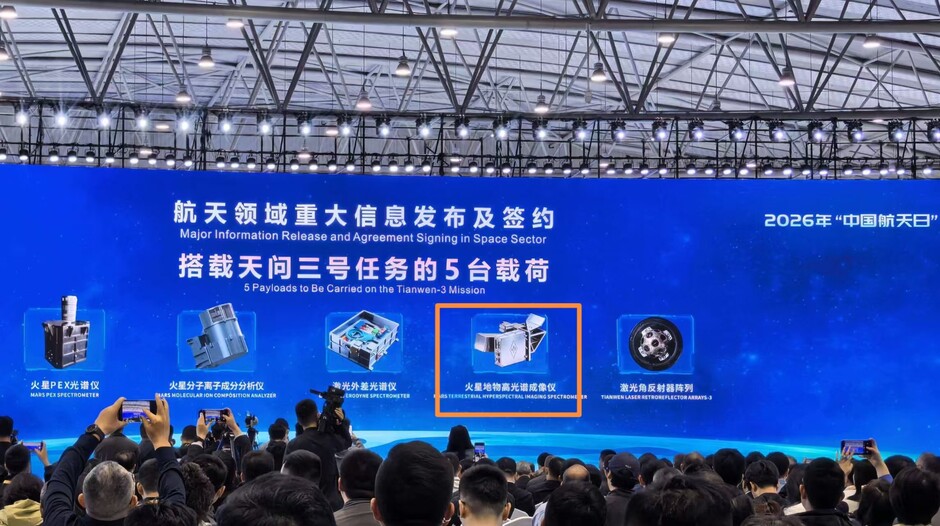
According to the selection results recently released by the China National Space Administration, HKU Science will participate in China’s first Mars Sample Return mission, Tianwen-3.
The Short-Wavelength Infrared Spectrometer, led and developed by the HKU Department of Earth and Planetary Sciences (DEPS), has been selected as a payload for deployment on the service module of the Tianwen-3 mission.
The orbital spectrometer will monitor Martian dust storms to support safe landing operations, conduct high-resolution mineralogical mapping of candidate landing sites, and continue long-term observations of Mars’s low-latitude regions after the sample return phase. It will play a critical role in searching for biosignatures, detecting hydrous minerals, and surveying Martian resources.
The project is led by Professor Yiliang LI of the Department of Earth and Planetary Sciences at HKU, with major collaborating institutions including Zhejiang University and the Chinese Academy of Sciences’ Changchun Institute of Optics, Fine Mechanics, and Physics.
In addition, the Tianwen-3 orbiter will carry three collaborative payloads, including the COSPAR-led Mars PEX Spectrometer, in which the HKU Laboratory for Space Research, led by Professor Quentin Parker, participates alongside Shenzhen University. Designed to search for traces of life on Mars and analyse surface mineral composition, the instrument will help investigate potential organic compounds and their distribution on the Martian surface.
You may also be interested in

07 Oct 2026

01 Sep 2026

23 Aug 2026

17 Aug 2026

09 Aug 2026

15 Jun 2026