

15 Jun 2026
Ancient Climate Shaped Hidden Freshwater Beneath the Pearl River Estuary
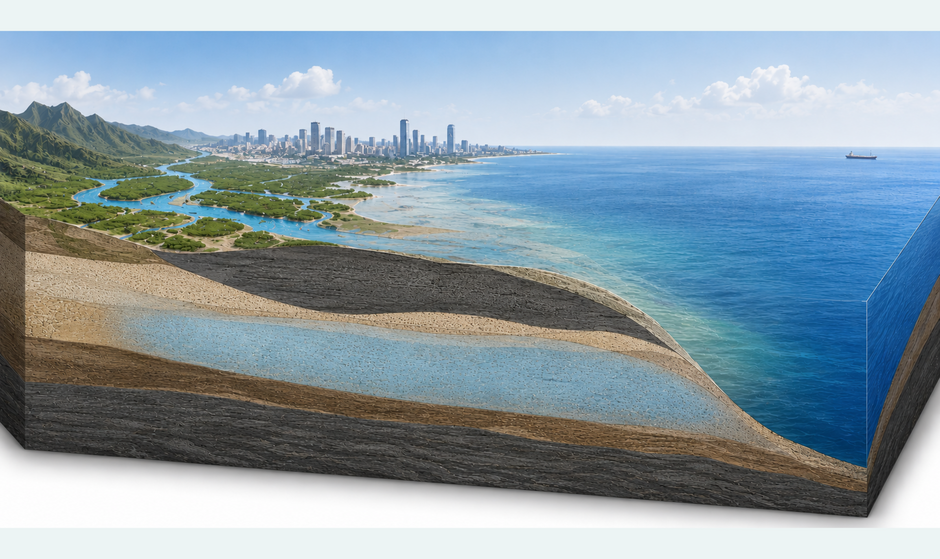
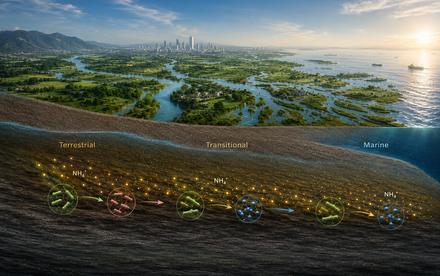
Conceptual illustration showing ancient freshwater preserved beneath the Pearl River Estuary seabed after being recharged by rainfall during past low sea-level periods.
Estuaries and nearby continental shelves are where river systems meet the sea. These coastal regions not only support dense populations and economic activity, but also preserve important records of past climate changes, sea-level rise and fall, and the long-term evolution of groundwater systems.
A collaborative research team from the Department of Earth and Planetary Sciences at The University of Hong Kong, together with Xiamen University, the Yantai Institute of Coastal Zone Research of the Chinese Academy of Sciences, the GEOMAR Helmholtz Centre for Ocean Research Kiel in Germany, and other institutions, studied the Pearl River Estuary and its adjacent continental shelf.
The team found that the widely distributed relatively fresh groundwater beneath the seabed in this region is not part of the modern groundwater cycle. Instead, it is ancient freshwater that was recharged by rainfall during a low sea-level period in the Late Pleistocene, when large areas of today’s seabed were still exposed as land. The findings were published in Science Advances under the title “Multimillennial climate-freshwater legacy beneath a large-river delta-front estuary.”
During the Late Pleistocene, global sea levels were much lower than today. Large areas of present-day continental shelves were exposed to land, allowing rainwater to seep into underground aquifers. As the climate warmed and sea level rose after the ice age, seawater gradually covered these areas. The deeper groundwater system then became largely cut off from modern recharge and circulation.
As a result, some of this ancient freshwater has remained preserved beneath the seabed for tens of thousands of years. This type of water is known as offshore, relatively fresh groundwater, or ORFG, meaning groundwater beneath the sea with a salinity of less than 10 grams per litre.
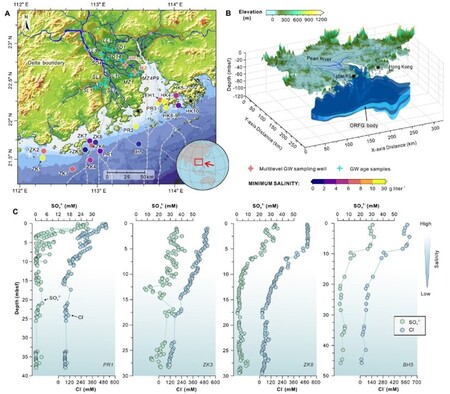
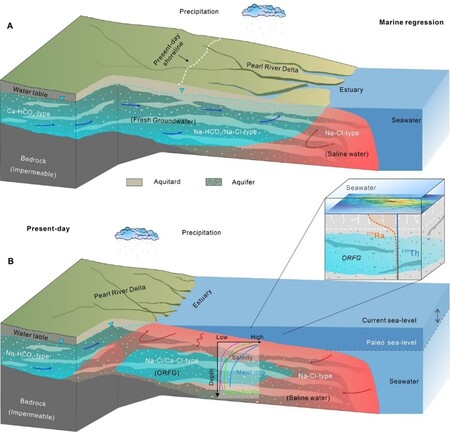
Figure 1(Left). Sampling locations and porewater profiles reveal a large ORFG body preserved beneath the Pearl River Estuary and adjacent continental shelf.
Figure 2 (Right). Conceptual model illustrating meteoric recharge and emplacement of ORFG during sea-level lowstands, followed by long-term preservation beneath the continental shelf during marine transgression.
In this study, the team used an integrated geochemical approach to trace the origin and history of the groundwater beneath the Pearl River Estuary and its adjacent shelf. Their results show that this ORFG system is not being sustained by present-day river water or modern groundwater flow from land. Rather, it is a relict freshwater reservoir formed during past climate and sea-level changes.
The findings provide new evidence that glacial–interglacial sea-level fluctuations played a direct role in shaping the distribution of freshwater resources beneath large river-delta margins. They also show that offshore freshwater can survive for very long periods when protected by low-permeability marine sediments, which act like a natural barrier between seawater and the deeper groundwater system.
The study adds to the growing scientific understanding that offshore, relatively fresh groundwater may be a globally significant yet underexplored water resource. However, because such systems may be largely isolated and only slowly replenished, they should not be treated as unlimited freshwater reserves. Further research is needed to assess their long-term sustainability and vulnerability to human activities and climate change.
The first author of the paper is Dr Chong Sheng, who completed much of the related work during his doctoral studies at The University of Hong Kong. He is currently a postdoctoral researcher at the GEOMAR Helmholtz Centre for Ocean Research Kiel in Germany, where his research focuses on coastal and continental shelf groundwater systems, hydrogeochemical processes, and numerical modelling. The corresponding author is Professor Jiu Jimmy Jiao from the Department of Earth and Planetary Sciences at The University of Hong Kong. The author team also includes Liuting Yuan, Pinghe Cai, Xin Luo, Jinchao Zuo, Kai Xiao, and Christian Hensen.
The study, titled “Multimillennial climate-freshwater legacy beneath a large-river delta-front estuary,” was published in Science Advances.
You may also be interested in
01 Sep 2026
23 Aug 2026

17 Aug 2026
09 Aug 2026

26 May 2026

12 May 2026