

15 Jul 2026
HKU Chemists Create New Carbon-Based Material for Future Sensors and Flexible Electronics
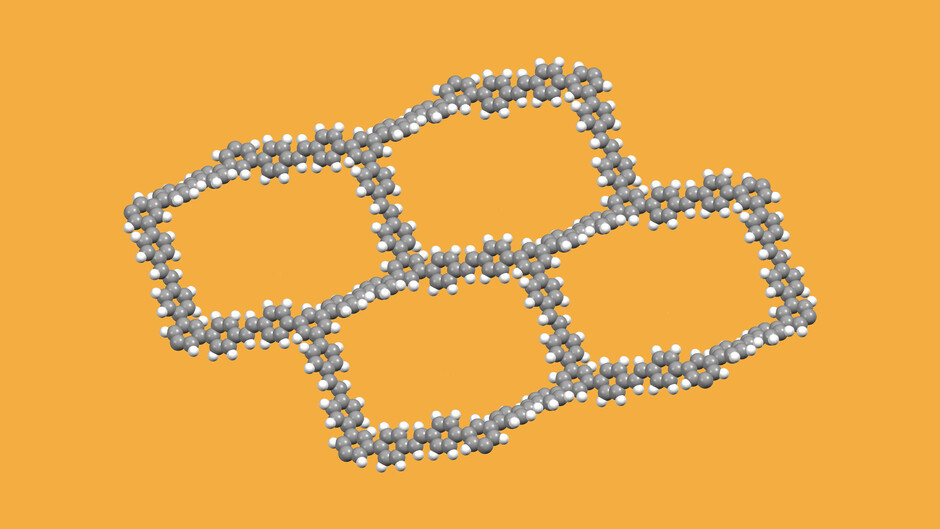
A research team led by Professors David Lee PHILLIPS and Seungkyu LEE of the Department of Chemistry at The University of Hong Kong (HKU) has developed a new two-dimensional carbon-based material, offering a strategy for building stable, ordered molecular frameworks for advanced technologies.
The material, named HKU-50, belongs to a class of materials known as covalent organic frameworks, or COFs. These materials are built from molecular units that connect into regular, repeating structures. HKU-50 is distinctive because its framework is made entirely from carbon and hydrogen, forming an ordered hydrocarbon structure with long-range crystallinity.
Creating such ordered all-carbon frameworks has long been impossible. Carbon–carbon bonds are strong and stable, but this also means that once molecules connect in the wrong way during synthesis, they are difficult to rearrange. As a result, scientists often obtain a disordered network, whose properties are harder to control, rather than a well-ordered crystalline material with clearer and more useful functions.
The HKU team overcame this challenge using a reaction known as olefin metathesis, which allows carbon–carbon double bonds to break and reform during synthesis. This reversibility gave the growing framework a chance to correct misplaced connections, helping it assemble into an ordered crystalline structure instead of a disordered network.
The resulting HKU-50 showed high thermal and chemical stability. Its ordered structure also significantly improved its light-emitting performance. Compared with the disordered version of the same material, HKU-50 showed a fourfold increase in photoluminescence quantum yield — a measure of how efficiently a material converts absorbed light into emitted light. This suggests that the ordered structure not only makes the material easier to study and control, but also directly enhances its optical properties.
The findings provide a new route for constructing crystalline hydrocarbon frameworks, a long-standing challenge in materials chemistry. In the future, such materials may support the development of flexible electronics, chemical sensors and other advanced light-emitting technologies.
The study was published in the Journal of the American Chemical Society and highlighted on the journal’s cover, as well as in Chemical & Engineering News.
You may also be interested in
25 Aug 2026
12 Jul 2026

26 Jun 2026
27 May 2026
05 May 2026
20 Apr 2026