- Date & Time
- October 22, 2025 (Wednesday) | HKT 4:45 pm - 6:30 pm
- Venue
- Rayson Huang Theatre, Main Campus, HKU, Pokfulam Road, Hong Kong ( Map )
- Language
- English
- Speaker
- Professor John Richard BOND
Shaw Laureate in Astronomy 2025; Professor at the Canadian Institute for Theoretical Astrophysics; University Professor at the University of Toronto, Canada - Professor George EFSTATHIOU
Shaw Laureate in Astronomy 2025; Emeritus Professor of Astrophysics (1909) at the University of Cambridge, UK
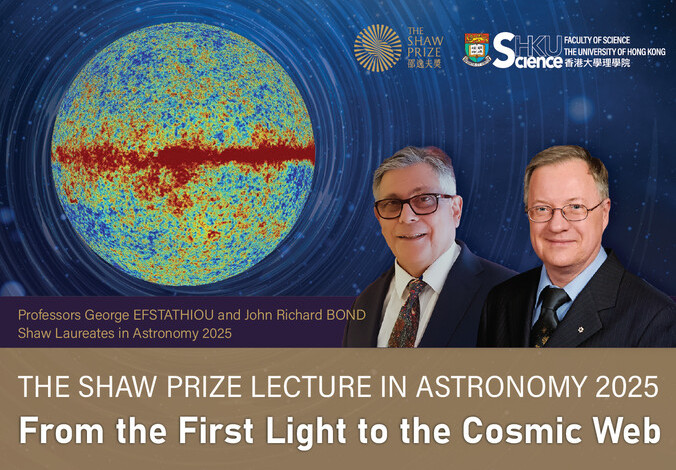
The Shaw Prize in Astronomy 2025 is awarded in equal shares to John Richard Bond, Professor of the Canadian Institute for Theoretical Astrophysics and University Professor at the University of Toronto, Canada and George Efstathiou, Professor of Astrophysics at the University of Cambridge, UK, for their pioneering research in cosmology, in particular for their studies of fluctuations in the cosmic microwave background. Their predictions have been verified by an armada of ground-, balloon- and space-based instruments, leading to precise determinations of the age, geometry, and mass-energy content of the universe.
Abstract
The cosmic microwave background (CMB) — the afterglow of the Big Bang — has transformed our understanding of the Universe. Tiny temperature fluctuations in the CMB have provided a gold mine of information about the early Universe.
Observations of the CMB have led to very strong evidence that the Universe experienced an inflationary period of rapid expansion at early times, and that at late times it is dominated by dark matter and dark energy. These features have led to the emergence of the ΛCDM model as the standard model of cosmology, with parameters exquisitely defined by the Planck satellite and ground-based experiments. Yet the component parts of the ΛCDM model are still not understood at a fundamental level.
In the first part of this lecture, Professor Efstathiou will review the prospects of learning about inflation, dark matter and dark energy over the next few years, with particular emphasis on recent claims that dark energy may be evolving. In the second part, Professor Bond will focus on the transport of photons, neutrinos, and gravitational waves from the early Universe to now and results from the Atacama Cosmology Telescope (ACT), complementing Professor Efstathiou’s emphasis on Planck and ΛCDM.


Speaker Professor John Richard BOND
Shaw Laureate in Astronomy 2025; Professor at the Canadian Institute for Theoretical Astrophysics; University Professor at the University of Toronto, Canada
Professor John Richard BOND was born in 1950 in Toronto, Canada, and is currently a Professor of the Canadian Institute for Theoretical Astrophysics and University Professor at the University of Toronto, Canada. He received his Bachelor’s degree from the University of Toronto in 1973 and a PhD from the California Institute of Technology, USA, in 1979. Following postdoctoral fellowships at the University of California, Berkeley, USA, and the University of Cambridge, UK, he was appointed Assistant Professor (1981–1985), then Associate Professor (1985–1987) at Stanford University, USA. In 1985, he moved to the Canadian Institute for Theoretical Astrophysics (CITA) at the University of Toronto, where he served as Professor until 2000 and has held the title of University Professor since 2000. He also served as Director of CITA for a decade (1996–2006). He is a Fellow of the Royal Society of Canada, the Royal Society of London, the American Physical Society, and is an International Honorary Member of the American Academy of Arts and Sciences and an International Member of the US National Academy of Sciences.

Speaker Professor George EFSTATHIOU
Shaw Laureate in Astronomy 2025; Emeritus Professor of Astrophysics (1909) at the University of Cambridge, UK
Professor George EFSTATHIOU was born in 1955 in London, UK and is currently Emeritus Professor of Astrophysics (1909) at the University of Cambridge, UK. He received his BA in Physics from the University of Oxford, UK, in 1976 and his PhD in Astronomy from Durham University, UK, in 1979. He held postdoctoral fellowships at the University of California, Berkeley, USA (1979–1980), and the University of Cambridge (1980–1988). He was Savilian Professor of Astrophysics (1988–1997) at Oxford, where he served as Head of Astrophysics until 1994. He returned to Cambridge in 1997 as Professor of Astrophysics, where he also served as Director of the Institute of Astronomy (2004–2008) and the first Director of the Kavli Institute for Cosmology (2008–2016). He received the 2022 Gold Medal of the Royal Astronomical Society. He is a Fellow of the Royal Society of London and the Royal Astronomical Society, UK.