



AI-generated image illustrating what the HKU Chang'e-7 lunar lander wide-field telescope camera may observe in November 2027.
“Only by building trust through international cooperation and working together can we achieve
breakthroughs in space exploration.”
— Professor Quentin PARKER, Director, Laboratory for Space Research
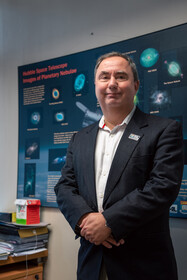
Professor Quentin Parker, Director of Laboratory for
Space Research
At HKU, the Laboratory for Space Research (LSR) has evolved precisely along this trajectory. From its origins in fundamental astrophysics, the Laboratory is now embedded in major space missions, international scientific infrastructure, and policy-relevant dialogue.
Keynote speaker Professor Brian SCHMIDT, 2011 Nobel Laureate in Physics, 2006 Shaw Prize Laureate in Astronomy, and President-elect of the IAU. | In a field defined by collaboration, credibility is measured not by visibility alone but by peers’ confidence. LSR’s standing as a trusted international partner was clearly demonstrated when it hosted the 7th China-Chile Bilateral Conference for Astronomy in January 2026, followed shortly by the Asia-Pacific Regional IAU Meeting (APRIM) in early May 2026. As one of the largest gatherings under the auspices of the International Astronomical Union (IAU), APRIM brought together leading scientists, policymakers, and industry participants from more than 40 countries across the Asia Pacific, including Nobel, Shaw and Gruber Cosmology Prize laureates, to explore developments in astrophysics, deep space exploration, and the emerging space economy, with space sustainability featured as a dedicated parallel meeting. More than a scientific conference, APRIM served as a “vote of confidence” in Hong Kong and HKU-LSR as an effective, neutral and reliable venue for international scientific engagement, reinforcing LSR’s role as a place where global conversations can unfold with openness, rigour and mutual trust. |


The distribution of satellites and space debris in Low Earth Orbit. Objects are shown greatly enlarged to visualise their locations;
in reality, most are far smaller. Image provided by Dr Andy Chung To KONG
 Embedded in Space Missions
Infrastructure for the Ages
To ensure its permanence, the database is being integrated into the Centre de Données astronomiques de Strasbourg (CDS), the world’s premier astronomical data system. By embedding this resource within a permanent global framework, LSR ensures that its commitment to open science will serve generations of explorers yet to come.
Where Science Meets Society
LSR has also engaged in dialogue on the emerging aerospace and NewSpace economy, exploring how Hong Kong’s strengths in professional services, finance and international connectivity can complement scientific and technological advances, in alignment with China’s strategic national priorities. A recent policy workshop co-organised by LSR brought together leaders from industry and academia, resulting in a series of recommendations to the HKSAR Government on positioning Hong Kong within the global space economy.
“I think Hong Kong has an ace card in the NewSpace economy,” Parker observes. “Its role is not in building satellites, but in acting as a scientific and mission connector. China is emerging as a major space science power, and these activities, many of them of strong public interest, are driving technological innovation at the highest levels of our universities.”
A Global Outlook
 |  |
The ILO-C small wide-field telescope, developed by HKU LSR and ILOA, will capture images of the Galactic plane from the Moon on the Chang’e-7 mission. | CubeSat prototype. A 1U CubeSat is a standard 10 × 10 × 10 cm miniature satellite capable of carrying payloads such as cameras and other sensors for space exploration. Prototype created by Dr Andy Chung To Kong, LSR. |
| < Previous | Next > |