

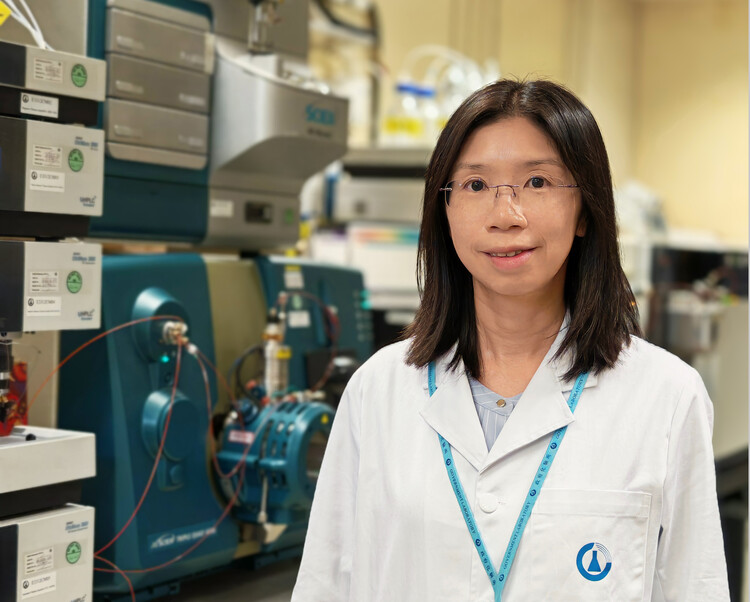
“Chemistry is not just a subject, it’s a way of training and thinking that helps you solve
real-world problems.”

Dr Ella WONG
• Chemist, Government Laboratory,
HKSAR
• Postdoctoral Fellow, HKU
• PhD in Chemistry, HKU
• BSc in Chemistry, HKU
When people think of public health and safety, they picture hospitals or emergency services. Few imagine a chemist in a government laboratory, quietly analysing powders, herbs, and mystery substances that may hold the key to urgent poisoning cases or hidden health threats. Yet this is exactly where HKU Chemistry alumna Dr Ella WONG has built her career—in a role where science meets responsibility, and every test result could protect thousands.
Since joining the Government Laboratory in 2012, Wong has worked across several key sections, from pharmaceutical chemistry to Chinese medicine safety. She now focuses on ensuring the safety and quality of Chinese herbal medicines and proprietary Chinese medicines in Hong Kong—using science to protect the public.
A Day in the Lab: Science That Protects Society
Wong’s day begins with a stack of incoming samples from different government departments—each one a tiny mystery with potentially serious consequences. “Every sample is a puzzle,” she laughs. “Some days it’s a tablet where we need to confirm its active ingredients. Other days, it’s a slimming product suspected to contain undeclared western drugs such as sibutramine; and sometimes it’s an unlabelled white powder from an intoxication case—something we must identify urgently.”
She currently focuses on testing for harmful residues or substances (e.g., pesticide residues, heavy metals, aflatoxins, and sulfur dioxide) in Chinese medicines on the local market. Advanced analytical techniques such as high-performance liquid chromatography and tandem mass spectrometry are part of her daily toolkit, enabling her to detect harmful substances at extremely low concentrations.
Then there are the emergencies—cases of suspected intoxication where every minute counts. Imagine a bag of dried herbs, or the remnants of decocted Chinese medicine, alleged to be contaminated with toxic herbs containing toxic alkaloids such as atropine. As the chemist-in-charge, she must design the right analytical approach and lead the scientific investigation. Her findings provide scientific evidence to support the authorities in removing dangerous products from shelves. She is also involved in R&D projects aimed at extending the existing analytical capabilities and developing innovative testing protocols, enabling the laboratory to provide new services in response to evolving regulations and emerging threats. When required, she will act as an expert witness in the court to provide scientific evidence for legal proceedings to present and explain her findings.
Two Defining Achievements
Among Wong’s many R&D projects, two stand out as milestones in her career.
The first was a highly challenging case involving ultra-trace detection of botulinum toxins— substances so toxic that even minute amounts require extraordinary care and analytical sensitivity. Conventional methods were proven inadequate. She had to design a new analytical strategy from scratch.
Using her deep understanding of the toxin’s biochemical properties, she engineered a custom molecular substrate selectively cleaved by the toxin’s unique activity. This breakthrough enabled definitive detection and quantification at unprecedented sensitivity. The method was later presented at major international platforms, including the PAWG-CCQM workshop at BIPM in Paris—a proud achievement for her and for Hong Kong.
Her second major achievement was developing a new and effective clean-up technique for pesticide multi-residue analysis in plant-based Chinese medicines. As the regulatory standards tightened and the list of regulated pesticides expanded, existing methods could no longer handle the complexity of different herbal matrices. She optimised the extraction and purification steps, enhancing recoveries while minimising interferences—“like finding a needle in a haystack,” she recalls. The final method became a robust, versatile tool that strengthened regulatory enforcement and protected public health. The method has been presented at an international conference and accepted for publication in a leading scientific journal.
“Those projects taught me that real science begins when things feel impossible. Each breakthrough was a quiet reminder that persistence and heart can carry you farther than you think.”
Why Chemistry?
 Her journey into chemistry began with a spark of pure curiosity. Watching the instant colour change in iodine clock reaction, “I was hooked. I wanted to know why. That moment shaped how I learn and how I approach science even today. And I realise that I love doing experiments!”.
 This spark grew into a passion when she joined HKU. She still remembers representing the University in the Hong Kong Chemistry Olympiad, “It was a powerful exercise in teamwork, critical thinking, and effective communication—skills that have continued to influence my approach to both research and academic challenges.”
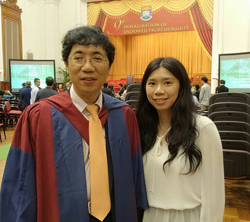
Professor Chi-ming Che, Chair Professor in the Department of Chemistry, was Ella’s mentor, who fuelled her passion for research and scientific inquiry.
If her early experiences lit the flame, it was Professor Chi-ming Che who helped shape it into a lifelong career. Under his supervision, she completed her undergraduate final-year project and later her PhD studies, synthesising and studying the anti-cancer and anti-viral properties of metal-based compounds. For the first time, seeing cancer cells killed selectively under the microscope in response to compounds she created was a moment she describes as “transformative”.
Professor Che’s mentorship was equally impactful. “He gave me freedom to explore in his multi-disciplinary research environment, yet always guided me with wisdom and clarity,” she says. “He balanced independence with support in a way that made me grow, not just as a scientist but as a person.” His influence continues to shape how she approaches challenges and opportunities today.
Advice to Aspiring Chemists
To students who dream of becoming chemists, her message is heartfelt and grounded:
“Build a strong technical foundation, and get as much hands-on experience as you can. Stay curious. Keep learning. Chemistry is not just a subject—it’s a way of training and thinking that helps you solve real-world problems. Explore widely, from daily life to research to industry to policy. And most importantly, be patient and persistent. Good science takes time.”
Serving the Society
For aspiring chemists passionate about making a tangible difference, GL offers a unique and rewarding pathway to public service. GL is one of the oldest government departments in Hong Kong, with the first government apothecary and analyst being appointed in 1879. Headed by the Government Chemist, the Laboratory is independent of all law-enforcement agencies and comprises two operational divisions, namely the Analytical & Advisory Services Division and the Forensic Science Division. Equipped with high-level, state-of-the-art analytical instrumentation, GL provides a wide range of quality analytical, forensic, and advisory services to government bureaux and departments in Hong Kong, enabling them to fulfil their responsibilities for law and order, food safety, public health, environmental protection, consumer protection, and the implementation of government policies.
Her journey shows how education, curiosity, and heart can grow into a life of purpose—using chemistry not only to solve problems but also to quietly protect the people around her.
| < Previous | Next > |