

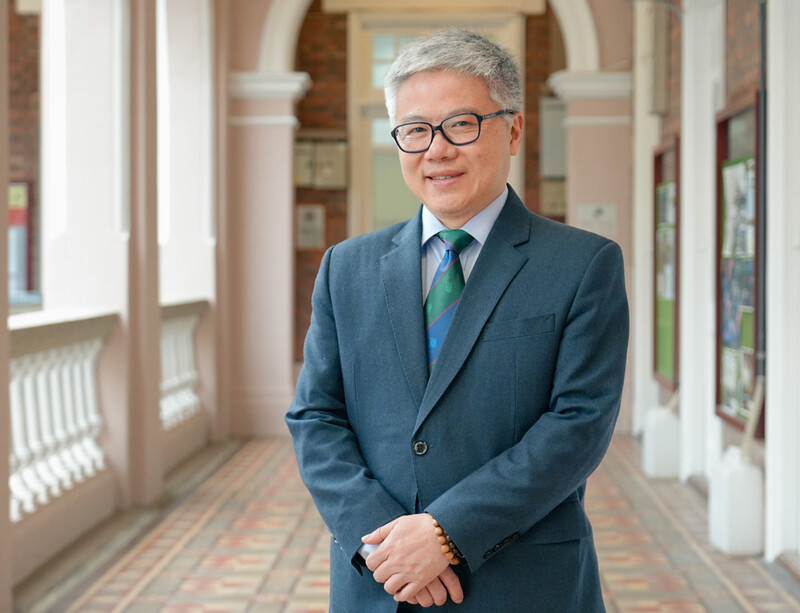
“Mathematics is, for me, one of the most human ways to make sense of the world. It is a process that unfolds over time.”
— Professor Bảo Châu NGÔ, Chair Professor in the Department of Mathematics, and recipient of the 2010 Fields Medal
Professor Bảo Châu NGÔ
- Chair Professor, HKU Department of Mathematics
- Fields Medal, 2010
- Clay Research Award, 2004
- Knight of the Legion of Honour (France)
- Fellow, American Mathematical Society
Eighteen years in Vietnam. Eighteen years in France. Eighteen years in the United States.
For Professor Bảo Châu NGÔ, a life in mathematics has unfolded in long, deliberate chapters rather than sudden leaps. Each phase, from early training in Hanoi, to intellectual formation in France, to recognition in the United States, reflects not just a change in place, but a gradual deepening of perspective.
Now, as he joins HKU, this pattern shifts once more. The move is less a break than a continuation, shaped by a personal desire to return closer to Asia and a growing conviction about the region’s future in science. “I began to believe that Asia would become a major centre for science and mathematics, with great opportunities to develop research,” he says.
Hong Kong, for him, is both a practical and intellectual choice. “Coming back to Asia, I really want to help develop stronger mathematical connections across Asia,” he adds. “There is a lot of room to build collaboration.” He also sees HKU as a place with room to grow. “I would like to help the Department of Mathematics become a world-class centre, and I’m really eager to contribute to that effort.”
From Hanoi to the World
Ngô’s journey began in Hanoi, in a family steeped in academia. His father, a mathematician, and his mother, a physician, created an environment where ideas were part of everyday life. His path into mathematics, at first, was not entirely smooth: the mathematician who would later win the Fields Medal failed his first attempt to enter a specialised mathematics school. The setback left a strong impression. “It upset me very much,” he recalls. “And I decided to study mathematics more seriously.”
Progress came gradually rather than suddenly. Over time, Ngô found himself drawn to the challenge itself, the process of working through problems, refining methods, and arriving at solutions. “When I was in high school, I was more interested in mathematics than anything else,” he recalls. From an early stage, he was already clear that this was the path he would pursue.
“I like the idea of finding solutions, being challenged and trying my best to overcome those challenges,” he explains. “Sometimes you don’t succeed the first time, but if the method is good, that is very gratifying.”
A Problem Reimagined
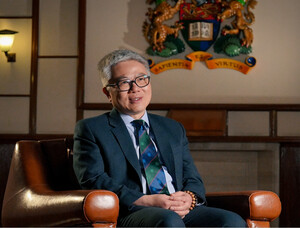 At the heart of Ngô’s work is a problem whose statement appears simple, but whose proof resisted mathematicians for decades. The Fundamental Lemma is, in essence, a statement that two very different ways of calculating the same quantity, each involving long and complicated formulae, eventually lead to the same result.
What made it so important was not the calculation itself, but its role. Over time, it became a key missing step in the Langlands programme, a vast framework connecting different areas of mathematics. Without it, many results could not be fully confirmed.
For years, mathematicians tried to solve it through direct calculation, but the problem resisted every attempt. Ngô took a different approach. Instead of calculating more, he tried to understand the deeper structure behind the formulae, reinterpreting the problem in geometric terms.
In 2004, together with his former advisor Gérard LAUMON, he proved the result in a special case, earning the Clay Research Award. But extending it further proved far more difficult. After several years of trying, he reached a point where he believed the approach could not work.
The breakthrough came in 2006, during a conversation with mathematician Mark GORESKY, who pointed out a missing piece: an idea that had been noted years earlier but never fully developed. With this insight, the problem finally began to open up.
Ngô went on to complete the proof in 2008, resolving the problem in full. The result unlocked a wide range of developments across the field, and in 2010, he was awarded the Fields Medal, the highest honour in mathematics.
Yet he describes the process not as a moment of triumph, but as a progression of understanding. “It takes many years,” he says. “You have to believe that it can be done.”
Understanding, Not Just Answers
For Ngô, mathematics is not defined by answers alone, but by the pursuit of understanding.
In a world increasingly driven by prediction, from financial models to artificial intelligence, he distinguishes between knowing what will happen and understanding why it happens.
“Some people are satisfied with predictions,” he says. “But for me, that is not enough. I want to understand why things happen.”
This perspective extends beyond mathematics itself. Questions about waves, flight, or natural phenomena may belong to physics, but they are ultimately expressed through mathematical structures. To understand those structures is, in part, to understand the world.
“I believe mathematics is an essential part of how humans make sense of the world,” he says.
Teaching, Thinking, and Sharing
At HKU, Ngô’s focus extends beyond research to how mathematics is taught and understood. He is critical of approaches that reduce the subject to formulae and procedures. “For a long time, we have been teaching mathematics in a very mechanical way, but that is not the best way to teach,” he notes.
Instead, he advocates an approach grounded in first principles—one that encourages students to understand ideas rather than apply them. “Once you understand something, you can do basic calculations, and then new questions arise. That’s how mathematics grows, from one question to another. For me, that is what we should learn from mathematics.”
Underlying this is a broader belief that mathematics should not be confined to specialists. Everyone, he argues, should be comfortable with a certain level of understanding. “More advanced mathematics is for professionals, but everyone should at least be able to make sense of the world through mathematics.”
This conviction has also shaped his outreach beyond academia, including co-authoring a children’s book that introduces mathematical ideas through storytelling.
A Life of Ideas and Exchange
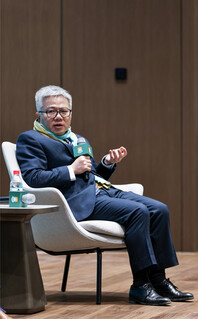 Outside mathematics, Ngô’s life is quietly consistent with his intellectual values. He reads extensively, enough to fill several walls of bookshelves, and finds increasing enjoyment in conversations with others.
“In the past few years, I really enjoy talking to people about their lives,” he says. Even in teaching, his preference reflects this emphasis on process and exchange. Despite technological advances, he still favours the blackboard. “It’s actually the best way to communicate mathematics,” he explains. Watching an idea unfold step by step allows students to follow not only the result but also the thinking behind it.
In the end, his work, his teaching, and his daily habits all point in the same direction: a sustained commitment to understanding and to sharing it with others.
As he begins this new chapter in Hong Kong, the pattern continues, not as a departure but as part of a longer journey shaped by time, curiosity, and quiet persistence.
Video Interview
| < Previous | Next > |