

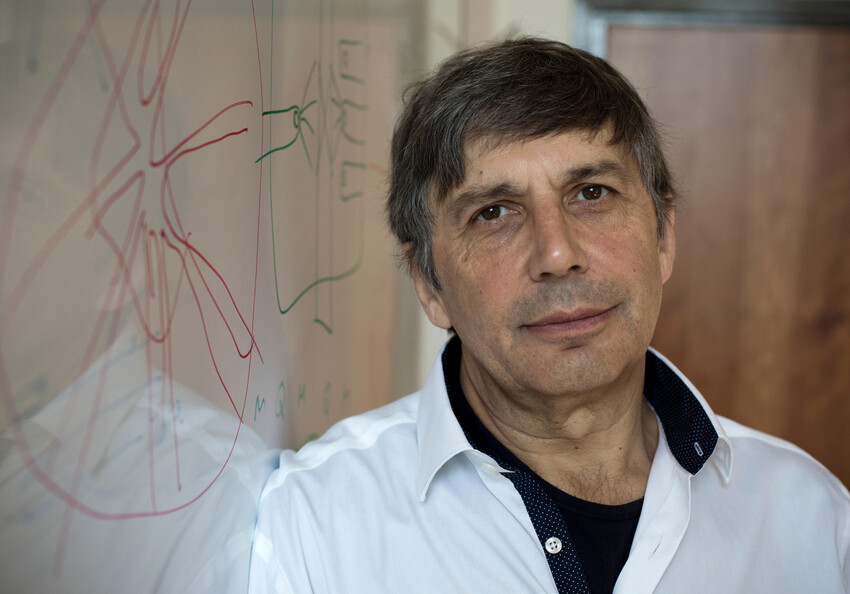
Image credit: Colin MCPHERSON/ Alamy Stock Photo
“Forbidden in nature doesn’t mean that we can’t trick around and make those materials.”
— Professor Sir Andre GEIM, Chair Professor in the Department of Physics, and Nobel Laureate in Physics 2010
- Chair Professor, HKU Department of Physics
- Nobel Prize in Physics, 2010
- Knight Bachelor, 2012 New Year Honours, for services to science
- Fellow of the Royal Society, UK
- Foreign Member of Chinese and USA Academies of Sciences
- Member of the National Academy of Sciences, USA

Professor Sir Andre Geim (left) in conversation with Professor Ferenc Krausz and other distinguished scholars at HKU@Shanghai’s “Meet Great Minds” discussion, sharing insights on scientific discovery as part of the University’s 115th anniversary celebrations.
The Radical Simplicity of Graphene
“Graphene was in front of our eyes for hundreds of years, in every pencil trace, and we simply didn’t realise it,” says Geim. For him, the lesson for HKU’s aspiring researchers is clear: the most profound discoveries are not always buried in complexity; they are often right in front of us, waiting for the right question to be asked.
Despite the global fame his discovery brought, Geim admits to a slight irritation at being pigeonholed as solely the “Father of Graphene”. He has long since moved past that initial breakthrough into what he terms “Graphene 3.0”. If graphene was the first tool, Geim’s work now focuses on building the entire toolbox.
“We know that graphene is not alone, that it has many sisters and brothers,” he explains. His current work explores a growing family of two-dimensional materials, assembling them layer by layer in carefully designed structures, almost like atomic-scale construction. By stacking different atom-thin crystals together, researchers can create “designer” materials with properties that do not exist in nature.
At HKU, he intends to continue this role as an atomic architect. He believes we are witnessing a fundamental shift in technological capability comparable to the transition from the Stone Age to the Bronze Age. “Human progress has often been defined by the materials we use,” Geim reflects, suggesting that we may be entering what he calls the “age of two-dimensional materials”.

Professor Andre Geim was awarded the 2010 Nobel Prize in Physics by King Carl Gustaf of Sweden during the Nobel award ceremony in the Concert Hall of Stockholm Sweden.
Image credit: TT News Agency/ Alamy Stock Photo
The Modern Philosopher’s Stone
To illustrate the tangible power of 2D materials, he points to a recent breakthrough using graphene flakes to extract gold from electronic waste. By dissolving e-waste in acid and filtering it through a graphene membrane, gold precipitates while other metals pass through. “In a sense, it’s kind of a philosopher’s stone at long last,” he quips. This ability to engineer systems with such precision is why Geim views graphene and its “siblings” as the best bet for the next technological revolution.
Curiosity Without Permission
As he settles into his new role, his message to the next generation of HKU scientists remains steadfastly humble. “There are still a lot of things to be discovered,” he says, “discoveries even the wisest people have never imagined.” Within the traces of a pencil or the ordinary objects around us, the next scientific revolution may already be waiting for someone curious enough to look again.
| < Previous | Next > |