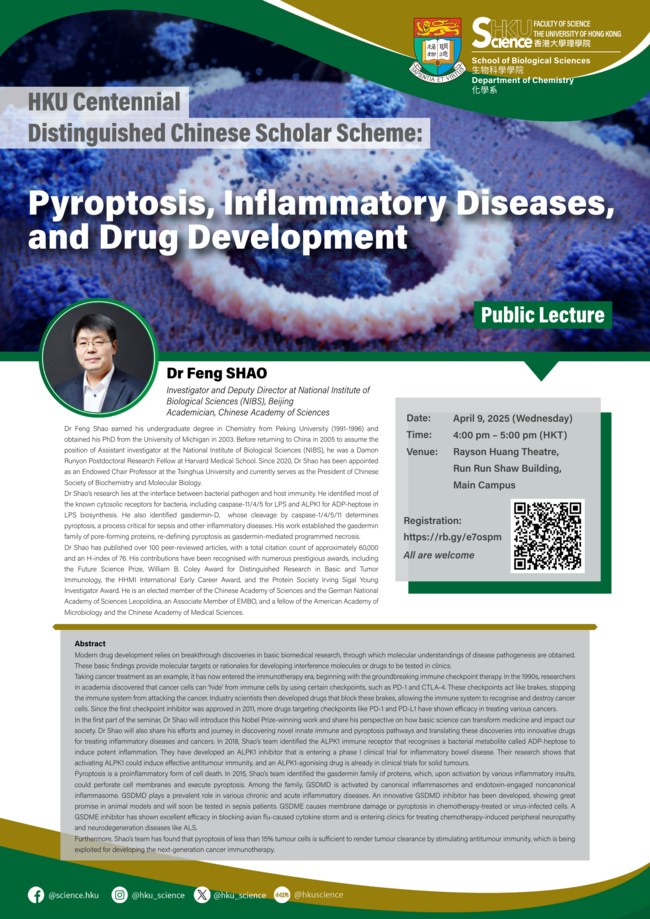
HKU Centennial Distinguished Chinese Scholar Public Lecture: Pyroptosis, Inflammatory Diseases, and Drug Development
- Date & Time
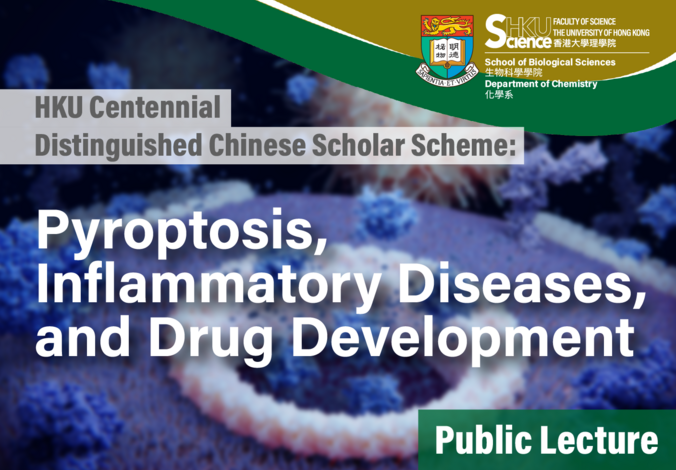
- April 9, 2025 (Wednesday) | 4:00 - 5:00 pm (HKT)
- Venue
- Rayson Huang Theatre, Run Run Shaw Building, Main Campus, HKU ( Map )
- Speaker
- Dr Feng SHAO
Investigator and Deputy Director at National Institute of Biological Sciences (NIBS), Beijing; Academician, Chinese Academy of Sciences
Modern drug development relies on breakthrough discoveries in basic biomedical research, through which molecular understandings of disease pathogenesis are obtained. These basic findings provide molecular targets or rationales for developing interference molecules or drugs to be tested in clinics.
Taking cancer treatment as an example, it has now entered the immunotherapy era, beginning with the groundbreaking immune checkpoint therapy. In the 1990s, researchers in academia discovered that cancer cells can ‘hide’ from immune cells by using certain checkpoints, such as PD-1 and CTLA-4. These checkpoints act like brakes, stopping the immune system from attacking the cancer. Industry scientists then developed drugs that block these brakes, allowing the immune system to recognise and destroy cancer cells. Since the first checkpoint inhibitor was approved in 2011, more drugs targeting checkpoints like PD-1 and PD-L1 have shown efficacy in treating various cancers.
In the first part of the seminar, Dr Shao will introduce this Nobel Prize-winning work and share his perspective on how basic science can transform medicine and impact our society. Dr Shao will also share his efforts and journey in discovering novel innate immune and pyroptosis pathways and translating these discoveries into innovative drugs for treating inflammatory diseases and cancers. In 2018, Shao’s team identified the ALPK1 immune receptor that recognises a bacterial metabolite called ADP-heptose to induce potent inflammation. They have developed an ALPK1 inhibitor that is entering a phase I clinical trial for inflammatory bowel disease. Their research shows that activating ALPK1 could induce effective antitumour immunity, and an ALPK1-agonising drug is already in clinical trials for solid tumours.
Pyroptosis is a proinflammatory form of cell death. In 2015, Shao’s team identified the gasdermin family of proteins, which, upon activation by various inflammatory insults, could perforate cell membranes and execute pyroptosis. Among the family, GSDMD is activated by canonical inflammasomes and endotoxin-engaged noncanonical inflammasome. GSDMD plays a prevalent role in various chronic and acute inflammatory diseases. An innovative GSDMD inhibitor has been developed, showing great promise in animal models and will soon be tested in sepsis patients. GSDME causes membrane damage or pyroptosis in chemotherapy-treated or virus-infected cells. A GSDME inhibitor has shown excellent efficacy in blocking avian flu-caused cytokine storm and is entering clinics for treating chemotherapy-induced peripheral neuropathy and neurodegeneration diseases like ALS.
Furthermore, Shao’s team has found that pyroptosis of less than 15% tumour cells is sufficient to render tumour clearance by stimulating antitumour immunity, which is being exploited for developing the next-generation cancer immunotherapy.
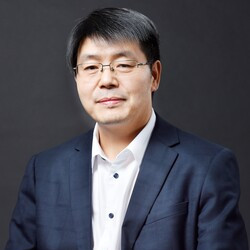
Speaker Dr Feng SHAO
Investigator and Deputy Director at National Institute of Biological Sciences (NIBS), Beijing; Academician, Chinese Academy of Sciences
Dr Feng Shao earned his undergraduate degree in Chemistry from Peking University (1991-1996) and obtained his PhD from the University of Michigan in 2003. Before returning to China in 2005 to assume the position of Assistant investigator at the National Institute of Biological Sciences (NIBS), he was a Damon Runyon Postdoctoral Research Fellow at Harvard Medical School. Since 2020, Dr Shao has been appointed as an Endowed Chair Professor at the Tsinghua University and currently serves as the President of Chinese Society of Biochemistry and Molecular Biology. Dr Shao’s research lies at the interface between bacterial pathogen and host immunity. He identified most of the known cytosolic receptors for bacteria, including caspase-11/4/5 for LPS and ALPK1 for ADP-heptose in LPS biosynthesis. He also identified gasdermin-D, whose cleavage by caspase-1/4/5/11 determines pyroptosis, a process critical for sepsis and other inflammatory diseases. His work established the gasdermin family of pore-forming proteins, re-defining pyroptosis as gasdermin-mediated programmed necrosis. Dr Shao has published over 100 peer-reviewed articles, with a total citation count of approximately 60,000 and an H-index of 76. His contributions have been recognised with numerous prestigious awards, including the Future Science Prize, William B. Coley Award for Distinguished Research in Basic and Tumor Immunology, the HHMI International Early Career Award, and the Protein Society Irving Sigal Young Investigator Award. He is an elected member of the Chinese Academy of Sciences and the German National Academy of Sciences Leopoldina, an Associate Member of EMBO, and a fellow of the American Academy of Microbiology and the Chinese Academy of Medical Sciences.