

01 Sep 2026
When Undergraduate Curiosity Uncovers Enceladus’ Uneven Space Environment
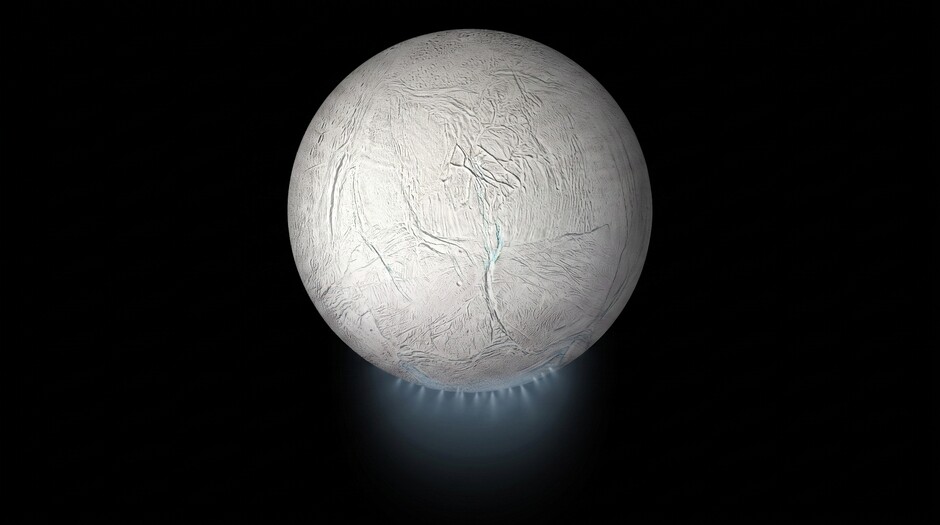
An illustration of Enceladus with its water plume emanating from the south pole (Credit: NASA/JPL-Caltech)
What began as a summer research project by an HKU undergraduate has developed into a peer-reviewed study revealing a striking asymmetry in the electron environment around Saturn’s icy moon Enceladus.
For HKU geology undergraduate Fiona LAW, an early curiosity about planetary science has led much further than she expected. A research project she began after her first year at HKU has now uncovered new clues about how Enceladus interacts with the charged particles surrounding Saturn. Fiona joined the Faculty of Science’s Summer Research Fellowship (SRF) Scheme after her first year, hoping to gain hands-on research experience and explore planetary science beyond the classroom.
Enceladus, Saturn’s geologically active icy moon, is known for the water plume erupting from its south pole. The interaction between this activity and the surrounding plasma environment has made the moon an intriguing target for planetary scientists.
Working under the supervision of Professor Zhonghua YAO, Associate Professor of Department of Earth and Planetary Sciences, Director of Laboratory for Space Science (LSR) and a member of The Hong Kong Institute for Astronomy & Astrophysics (HKIAA), Fiona investigated this complex environment using observations collected during NASA’s Cassini flybys of Enceladus. Professor Yao had initially proposed a project exploring possible connections between geological activity on icy moons and their surrounding space environments, laying the foundation for what would eventually become a publishable study.
Where the journey began
“I never imagined that I would have the chance to lead a research project as a Year 1 student, and I am grateful to Professor Yao for entrusting me with this precious opportunity,” Fiona said.
During the summer of her first year, Fiona was also allowed to attend international conferences in Earth and planetary sciences. The experience gave her an early glimpse into academic research, introduced her to cutting-edge developments in the field, and connected her with researchers from around the world.
Fiona’s first SRF project appeared to conclude with an exciting finding. She identified what looked like a correlation between Enceladus’ south-polar water plume and the density of electrons above the region. The result seemed to suggest a possible connection between geological activity on the moon and the charged-particle environment surrounding it.
However, research does not always follow the path researchers expect. When Fiona returned to the project after her second year and expanded the dataset, more detailed analysis showed that the apparent correlation was not a genuine physical relationship. Instead, it had arisen coincidentally from other patterns in the data.
Rather than abandoning the project, Fiona, Professor Yao and other members of the research group began investigating what had produced those patterns in the first place. This gradually shifted the project towards a different question: how are electrons distributed around Enceladus, and does that distribution change depending on where the spacecraft passes the moon?
Upstream and downstream tell different stories
To answer this question, the team systematically analysed data from Enceladus-targeted flybys conducted by NASA’s Cassini spacecraft, comparing measurements taken on the upstream and downstream sides of the moon.
Much like water flowing around a rock in a stream, plasma in Saturn’s magnetosphere flows past Enceladus. This means the moon has an upstream side, facing the incoming plasma flow, and a downstream region, or wake, behind it.
The researchers found that the two sides behave very differently. Downstream of Enceladus, electron density shows substantial depletion, while upstream of the moon the variations are comparatively minor. In other words, electrons are not distributed evenly around Enceladus: the surrounding plasma environment is distinctly asymmetric.
The finding provides new insight into the physical processes operating around Enceladus and how the moon interacts with Saturn’s surrounding plasma environment. By comparing multiple Cassini flybys rather than focusing on a single encounter, the study offers a broader view of how electron density varies around the moon.
Turning an unexpected result into a discovery
For Professor Yao, Fiona’s experience also demonstrates how modern research tools are making sophisticated scientific datasets increasingly accessible to younger researchers. “AI and other modern tools are making it far easier for younger students to get hands-on with real scientific data. They can quickly explore the fascinating world of science and make discoveries with truly fresh eyes. I hope that we’ll see many more undergraduates, and even high schoolers, joining our actual research projects in the years ahead,” Professor Yao said.
The experience gave Fiona an unusually early opportunity to work with real spacecraft data, engage with the professional research community and contribute to frontier planetary science. It also taught her one of the most important lessons in research: an initial result that does not stand up to closer scrutiny is not necessarily a dead end. Sometimes, understanding why an expected answer is wrong can open the door to a more interesting question, and ultimately, an unexpected discovery.
The resulting paper, “Asymmetric Distribution of Electron Density Near Enceladus: A Comparative Survey of Upstream and Downstream Cassini Flybys”, by Law et al., has been published in The Astrophysical Journal. The study reveals a pronounced difference in electron density between the upstream and downstream regions around Enceladus, providing new insights into the complex interaction between the icy moon and Saturn’s surrounding plasma environment.
View the paper with the following link:
You may also be interested in
23 Aug 2026

17 Aug 2026
09 Aug 2026

15 Jun 2026

26 May 2026
12 May 2026