

07 Oct 2026
Hidden phosphorus in coastal groundwater fuels global rise in algal blooms
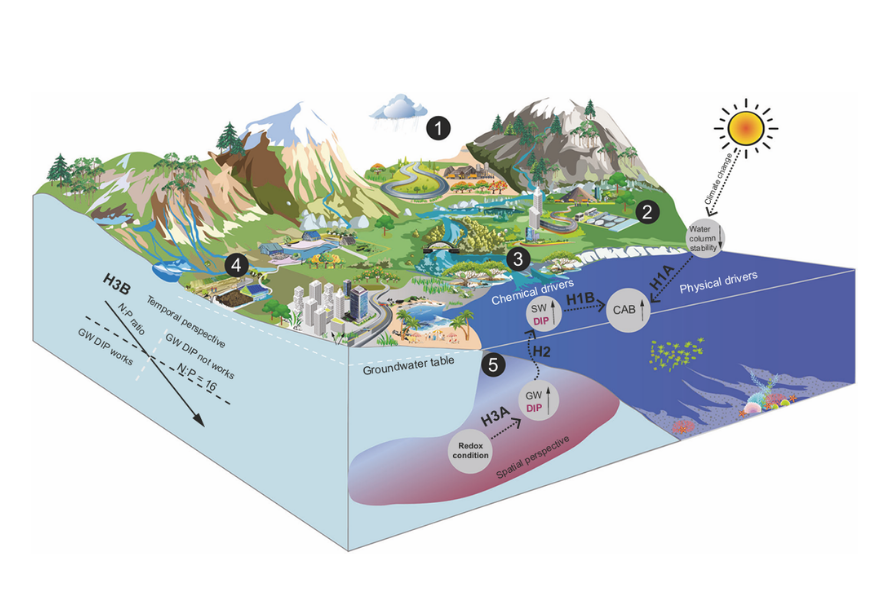
Figure 1. Conceptual model of coastal groundwater phosphorus driving the global acceleration of algal blooms. Image credit: Cheng et al., Nature Communications (2026), CC BY 4.0.
Professor Jiu Jimmy JIAO and Dr Xin LUO from the HKU Department of Earth and Planetary Sciences, together with Dr Kaihao CHENG from the Chinese University of Hong Kong, have published a research paper in Nature Communications titled “Coastal groundwater phosphorus drives global acceleration of algal blooms”.
The study reveals that excessive dissolved inorganic phosphorus (DIP) in coastal groundwater is a long-overlooked key driver of the global acceleration of coastal algal blooms (CABs), providing a new scientific basis for understanding the ecological paradox of worsening algal blooms despite nitrogen control measures.
Coastal algal blooms pose significant threats to marine ecosystems, fisheries, and human health, causing billions of dollars in economic losses worldwide each year. Although many regions have reduced nitrogen inputs over the past decades in an effort to curb blooms, their frequency and intensity have continued to rise, creating a well-known “ecological paradox”.
To investigate this paradox, the study combined a process-oriented physical-chemical framework with a global multi-decadal dataset, systematically analysing coastal chlorophyll-a concentrations, nutrients, and water column stability from 1998 to 2022. The analysis covered 237,540 coastal sites worldwide and integrated 1,533 paired groundwater-seawater DIP observations from 140 coastal groundwater sites.
The study found that phosphorus, rather than nitrogen or physical water conditions, was most closely linked to the worsening of coastal algal blooms worldwide. While dissolved inorganic nitrogen (DIN) declined over the study period, dissolved inorganic phosphorus (DIP) continued to rise, driving down the N:P ratio and creating conditions that favour algal blooms. Among the factors examined, chlorophyll-a showed the strongest correlation with DIP (r=0.74).
The researchers further traced this excess phosphorus to coastal groundwater. Their global analysis showed a strong link between groundwater and adjacent seawater DIP levels, revealing that groundwater can deliver phosphorus-rich, nitrogen-poor nutrients to coastal waters. In oxygen-depleted aquifers, phosphorus is released from iron oxides while denitrification removes nitrogen, producing groundwater with a particularly low N:P ratio.
High-resolution observations from Hong Kong and Delaware Bay provided further evidence: pulses of groundwater phosphorus occurred shortly before algal bloom events, temporarily pushing seawater N:P ratios below 16 and creating favourable conditions for blooms. The researchers describe this combined spatial and temporal control as a “spatio-temporal gating” mechanism, which helps explain why coastal algal blooms can continue to intensify even as nitrogen pollution declines.
The study establishes a new mechanistic framework linking groundwater, nutrient balance, and algal blooms, challenging the traditional focus on surface nutrient inputs alone. The findings show that even when surface nitrogen inputs are reduced, groundwater can continue to deliver dissolved inorganic phosphorus (DIP) to coastal waters and sustain algal blooms.
The researchers therefore highlight the need to incorporate groundwater flow and aquifer redox conditions into future monitoring and management strategies. Aquifer redox state may also indicate regional vulnerability, particularly as climate change and human activities could drive more aquifers toward reductive conditions and increase the risk of phosphorus-driven blooms.
The study further calls for incorporating groundwater DIP and its redox-driven release mechanisms into the next generation of coastal biogeochemical models, which currently tend to overlook the role of groundwater nutrient stoichiometry.
The first author, Dr Kaihao Cheng, graduated from the research group of Professor Jiu Jimmy Jiao at The University of Hong Kong and is currently a Research Assistant Professor in the School of Life Sciences at the Chinese University of Hong Kong. The co-corresponding authors are Dr Kaihao Cheng (CUHK), Professor Jiu Jimmy Jiao (HKU), Professor Jin Wu (HKU), and Dr Xin Luo (HKU). Collaborative institutions include the Chinese University of Hong Kong, the University of Hong Kong, the Macau University of Science and Technology, the University of California, Santa Cruz, the Woods Hole Oceanographic Institution, the University of Delaware, and Hainan University. This study was supported by multiple research funds.
Click here to read the journal paper.
You may also be interested in

01 Sep 2026

23 Aug 2026

17 Aug 2026
09 Aug 2026

15 Jun 2026

26 May 2026