

04 Nov 2026
HKU and Harvard Study Offers New Clues to the Quantum Origins of High-Temperature Superconductivity

Conceptual picture of the parton construction. Spinons carry spin, chargons carry electric charge, and both couple to a shared SU(2) gauge field. The highlighted composite represents the physical electron.
Conceptual picture of the parton construction. Spinons carry spin, chargons carry electric charge, and both couple to a shared SU(2) gauge field. The highlighted composite represents the physical electron.
Why can some materials conduct electricity without resistance at temperatures far above those of conventional superconductors? Despite decades of research, the answer remains one of the central puzzles in physics. A study by researchers at The University of Hong Kong (HKU) and Harvard University offers new numerical evidence for an unconventional idea: understanding these materials may require looking beyond electrons as indivisible carriers of spin and charge.
The research, by Dr Chuang Chen and Professor Zi Yang Meng of HKU’s Department of Physics, and Professor Subir Sachdev of Harvard University, uses numerical simulations on supercomputers to investigate a direct transition between an antiferromagnetic insulator and a d-wave superconductor. This transition offers a starting point for understanding the neighbouring magnetic and superconducting phases in the cuprate phase diagram. The findings support a scenario in which the electron’s spin and electrical charge are carried by distinct, emergent quantum excitations at the transition.
The Puzzle of High Temperature Superconductivity
Copper-based high-temperature superconductors, known as cuprates, provide the motivation for this work. Their parent materials are typically antiferromagnetic insulators: electrons do not conduct electricity freely, while their spins, tiny quantum magnetic moments, form an alternating pattern. Introducing mobile charge carriers can give rise to d-wave superconductivity. Explaining this phase diagram remains a fundamental challenge. Conventional Bardeen–Cooper–Schrieffer (BCS) theory describes superconductivity through electron pairing, but understanding the cuprates calls for ideas beyond the conventional picture of pairing mediated by lattice vibrations.
Looking Beyond the Electron
To investigate the connection between antiferromagnetic insulation and d-wave superconductivity in the cuprate phase diagram, the team constructed a two-dimensional parton model on a square lattice. In this description, the electron is represented using more fundamental degrees of freedom: spinons, which carry spin but no electrical charge, and chargons, which carry charge but no spin. This separation is known as electron fractionalisation. It describes how spin and charge can behave separately in a collective quantum system, rather than an electron physically breaking into smaller pieces.
The spinons and chargons interact through a fluctuating SU(2) gauge field, which mediates their interactions. Within this common framework, the d-wave superconductor emerges as a Higgs phase, in which chargons condense, while the antiferromagnetic insulator is a confined phase, in which spinons no longer exist as independent low-energy excitations. The model thus naturally connects contrasting states in the cuprate phase diagram and allows the team to investigate the transition between them.
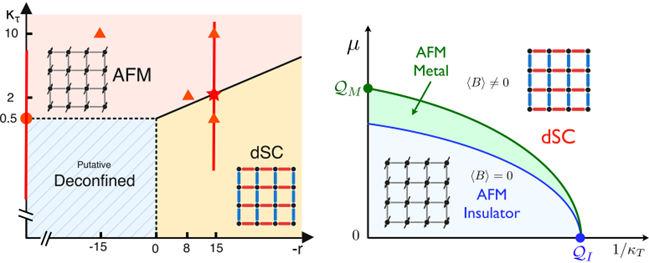
Phase diagrams. Left: the half-filled model studied with quantum Monte Carlo simulations, showing the antiferromagnetic insulator (AFM), d-wave superconductor (dSC), and a putative deconfined regime. Right: the proposed extension to non-zero doping, linking the half-filled quantum critical point to the broader cuprate phase diagram. The finite-doping diagram is a theoretical proposal.
Supercomputer Simulations Reveal an Unusual Quantum Transition
Using quantum Monte Carlo simulations on supercomputers, the team explored how these states emerge from the interacting partons and gauge field. The approach allowed them to weaken antiferromagnetic order while avoiding the “sign problem”, a computational obstacle that makes many simulations of interacting electrons prohibitively difficult.
The simulations revealed evidence for a direct, continuous transition between an antiferromagnetic insulator and a d-wave superconductor. In a d-wave superconductor, electron pairing depends on direction—a defining feature of superconductivity in the cuprates. The researchers also examined electron-like excitations and found that they could have arbitrarily low energies at particular momenta in the superconducting state, whereas an energy gap opened in the antiferromagnetic state.
Together, the results support a “deconfined quantum critical point”: an unusual boundary between two states of matter where fractionalised degrees of freedom become central to the physics. Unlike familiar changes such as ice melting when heated, this transition is driven by quantum fluctuations as interactions are tuned near absolute zero temperature.
New Clues to Cuprate Physics
The work provides a computational setting for testing ideas about electron fractionalisation and its connection to cuprate physics. Although the simulations concern a simplified model at zero doping, they offer a starting point for exploring how related physics might influence cuprates when mobile charge carriers are introduced. Establishing that connection more fully remains an important direction for future research.
Research paper: Chuang Chen, Subir Sachdev and Zi Yang Meng, “Deconfined criticality between an antiferromagnetic insulator and a nodal d-wave superconductor: a quantum Monte Carlo study”, Proceedings of the National Academy of Sciences (PNAS).

Evidence for a continuous quantum transition. Superconducting correlations weaken as antiferromagnetic correlations grow. Crossings of the corresponding correlation ratios for different system sizes locate a common transition region, while valence-bond correlations show enhanced fluctuations. The results support a direct, continuous transition between the two states.

How electron and spin excitations change across the transition. The upper row shows electron spectra and the lower row shows spin spectra. The columns compare the superconducting state (left), the antiferromagnetic state near the transition (middle), and the antiferromagnetic state farther from the transition (right). The electron spectrum changes from gapless nodes in the superconductor to a gapped spectrum in the antiferromagnet, while the spin response evolves towards spin-wave behaviour.
About the journal paper: Chen, C., Sachdev, S., & Meng, Z. Y. (2026). Deconfined criticality between an antiferromagnetic insulator and a nodal d-wave superconductor: A quantum Monte Carlo study. Proceedings of the National Academy of Sciences, 123(43), e2623874123.
Click here to learn more about the journal paper.
You may also be interested in
30 Sep 2026
09 Sep 2026

21 Jul 2026

21 Jul 2026

05 Jul 2026

09 Jun 2026