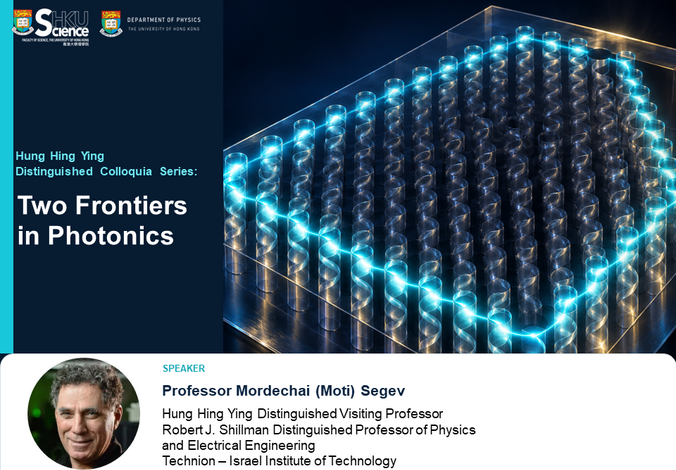
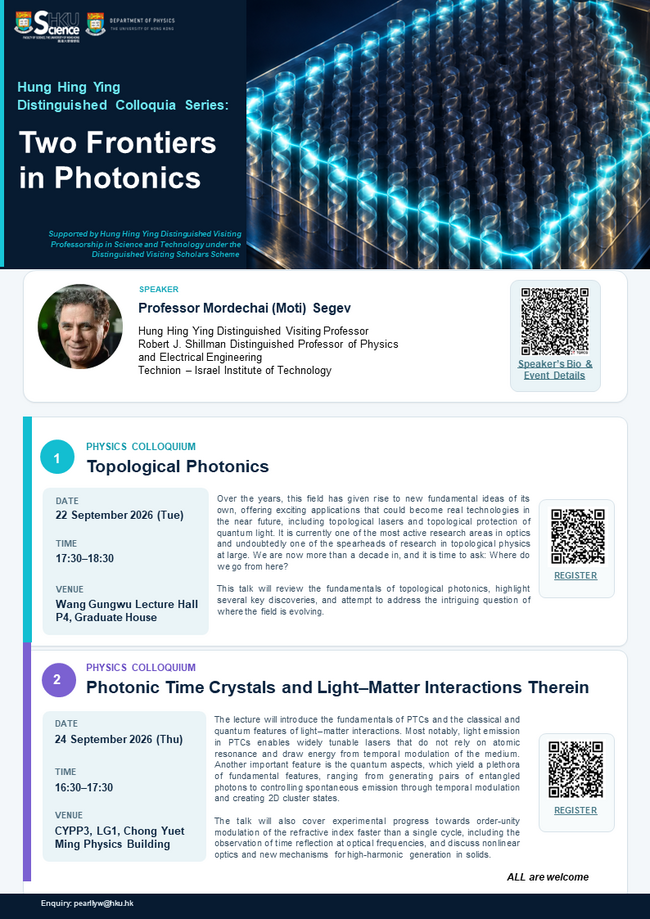
Hung Hing Ying Distinguished Colloquia Series: Two Frontiers in Photonics
- Date & Time
- September 22 & 24, 2026
- Venue
- Wang Gungwu Lecture Hall & CYPP3
- Speaker
- Professor Mordechai (Moti) Segev
Hung Hing Ying Distinguished Visiting Professor; Robert J. Shillman Distinguished Professor of Physics and Electrical Engineering, Technion – Israel Institute of Technology
Supported by Hung Hing Ying Distinguished Visiting Professorship in Science and Technology under the Distinguished Visiting Scholars Scheme
Physics Colloquium: Topological Photonics
Date: September 22, 2026 (Tuesday)
Times: 17:30-18:30
Venue: Wang Gungwu Lecture Hall, P4, Graduate House (Map)
Moderator: Professor Shuang Zhang (Department of Physics, Faculty of Science, The University of Hong Kong)
Registration: https://forms.cloud.microsoft/r/0vYrBn0KRZ?origin=lprLink
Abstract:
The research field of Topological Photonics started in 2013, with the first experimental observation of Photonic Topological Insulator. The field introduced fundamental concepts from solid-state physics into photonics, among them the profound discovery that transport of light waves can be protected from scattering by disorder, defects and imperfections. Over the years, this field has triggered new fundamental ideas of its own, offering exciting ideas such as topological lasers and topological protection of entangled photon states. It is currently one of the most active research areas in optics and undoubtedly one of the spearheads of research in topological physics at large.
This lecture will review the fundamentals of topological photonics, highlight several key discoveries, and attempt to address the intriguing question on where the field is evolving.
Physics Colloquium: Photonic Time-Crystals and Light-Matter Interactions Therein
Date: September 24, 2026 (Thursday)
Times: 16:30-17:30
Venue: CYPP3, LG1, Chong Yuet Ming Physics Building (Map)
Moderator: Professor Yi Yang (Department of Physics, Faculty of Science, The University of Hong Kong)
Registration: https://forms.cloud.microsoft/r/5cD0kyB3Br?origin=lprLink
Abstract:
Photonic Time Crystals (PTCs) are dielectric media whose refractive index is strongly modulated periodically in time, at time scales shorter than a single optical cycle. These systems conserve momentum but not energy, and are characterized by momentum bands separated by band-gaps where the amplitudes of their eigenmodes can increase or decay exponentially.
The colloquium will introduce fundamentals of PTCs along with the classical and quantum features of light-matter interactions in PTCs. Among these, most notable is the emission of light in PTCs, which opens new avenues for widely tunable lasers that do not rely on any atomic resonance, and the quantum aspects, which yield a plethora of fundamental features such as generation of pairs of entangled photons, and controlling spontaneous emission through the temporal modulation. The colloquium will present the experimental progress on order-unity modulation of the refractive index faster than a single cycle, and the recent breakthrough of observing time-reflection at optical frequencies. Last but not least, nonlinear optics in such time-varying media will be discussed, envisioning new mechanism for high harmonic generation in solids.
ALL are welcome.
Enquiry: pearllyw@hku.hk
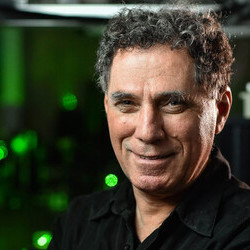
Speaker Professor Mordechai (Moti) Segev
Hung Hing Ying Distinguished Visiting Professor; Robert J. Shillman Distinguished Professor of Physics and Electrical Engineering, Technion – Israel Institute of Technology
Moti Segev is the Robert J. Shillman Distinguished Professor of Physics and Electrical Engineering, at the Technion, Israel. He received his BSc and PhD from the Technion in 1985 and 1990. After postdoc at Caltech, he joined Princeton University as Assistant Professor (1994), becoming Associate Professor in 1997, and Professor in 1999. Subsequently, Moti went back to Israel, and in 2009 was appointed as Distinguished Professor. Moti's interests are mainly in photonics, solitons, lasers, and quantum optics. He won numerous international awards, among them the 2007 Quantum Electronics Prize of the European Physics Society, the 2009 Max Born Award of the Optical Society of America, and the 2014 Arthur Schawlow Prize of the American Physical Society. In 2011, he was elected to the Israel Academy of Sciences, in 2015 to the National Academy of Science (USA), and in 2021 to the American Academy of Arts and Sciences (AAAS). In 2014 Moti Segev won the Israel Prize (highest honor in Israel) in Physics, in 2019 he has won the EMET Prize in Physics, and in 2024 he won the Rothschild Prize in Physics. In 2020 he was elected to be the Neil Armstrong Distinguished Visiting Professor at Purdue University, and in 2023 he won an Honorary PhD from the University of Quebec. However, above all his personal achievements, Moti takes pride in the success of his graduate students and postdocs, among them are currently 27 professors in the USA, Germany, Croatia, Italy, India, China, Switzerland and Israel, and many holding senior R&D positions in the industry.