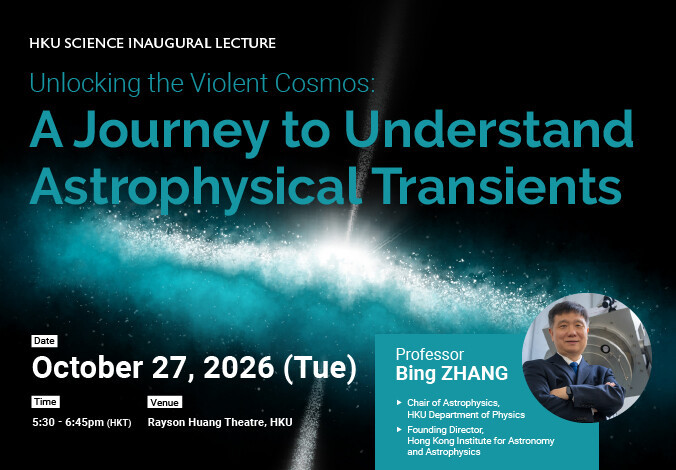
HKU Science Inaugural Lecture Series: Unlocking the Violent Cosmos: A Journey to Understand Astrophysical Transients
- Date & Time
- October 27, 2026 (Tuesday) | 5:30 pm - 6:45 pm (HKT)
- Venue
- Rayson Huang Theatre, HKU ( Map )
- Language
- English
- Speaker
- Professor Bing ZHANG
Chair of Astrophysics, HKU Department of Physics; Founding Director, Hong Kong Institute for Astronomy and Astrophysics
20260924-Professor Bing ZHANG_1000.jpg)
Abstract
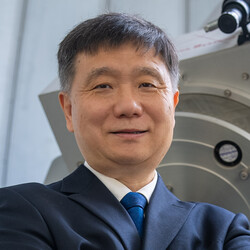
Speaker Professor Bing ZHANG
Chair of Astrophysics, HKU Department of Physics; Founding Director, Hong Kong Institute for Astronomy and Astrophysics
Professor Bing Zhang is Chair of Astrophysics in the Department of Physics and Founding Director of the Hong Kong Institute for Astronomy and Astrophysics at The University of Hong Kong. He joined HKU in 2025 as a Global STEM Professor. He earned a BSc, an MSc and a PhD from Peking University, conducted postdoctoral research at NASA’s Goddard Space Flight Center and Pennsylvania State University, and was a Distinguished Professor at the University of Nevada, Las Vegas, before joining HKU. An internationally recognised theoretical astrophysicist, Professor Zhang’s research focuses on high-energy and transient astrophysics, including gamma-ray bursts, fast radio bursts, neutron stars, black holes, and multi-messenger phenomena. His work combines theoretical modelling with multi-wavelength and multi-messenger observations to investigate the physical mechanisms powering some of the most energetic and rapidly evolving events in the Universe. He has published more than 650 refereed papers, including about 30 in Nature or Science, and is a Fellow of the American Physical Society and a co-recipient of the Bruno Rossi Prize. He plays a leadership role in several of China’s major astronomical space missions and telescopes, including Einstein Probe (EP), Space Variable Objects Monitor (SVOM), and the Five-hundred-meter Aperture Spherical Radio Telescope (FAST).