Start main content

Spotlights

Physical Laws Across the Universe

Department of Physics


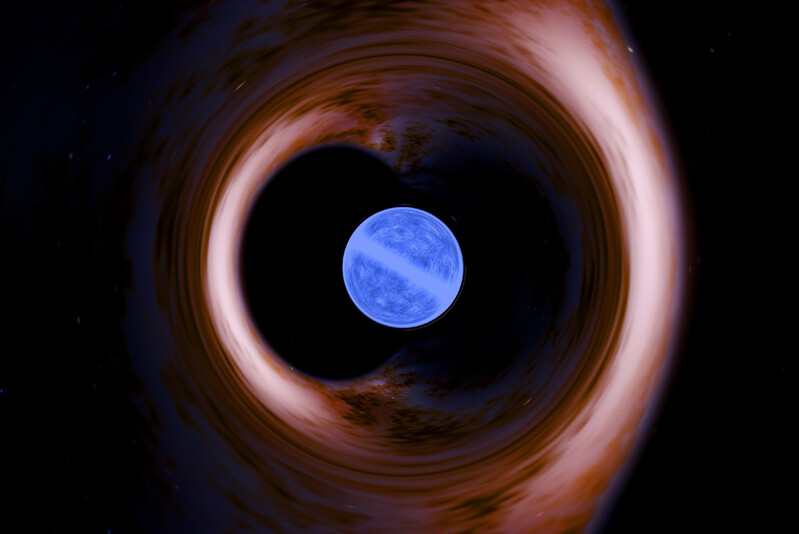
A 3D illustration of the neutron star PSR J0952–3839, which holds the record as the most massive neutron star known as of 2022.

An illustration of a neutron star.

Physics gives us the language to understand every world, from the planets we know to those we have yet to imagine.
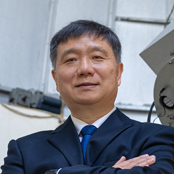
Professor Shuang ZHANG, Interim Head, Department of Physics

Professor Shuang ZHANG, Interim Head, Department of Physics

Professor Shuang ZHANG, Interim Head, Department of Physics.

Astrophysical and planetary science at HKU is underpinned by a discipline that illuminates the workings of the Universe at its most fundamental level: physics. As the language through which nature’s laws are expressed, physics provides the conceptual scaffolding for understanding how planets and moons form, move and evolve as well as how matter behaves across a much broader range of astrophysical environments. Within the Department of Physics, this foundation becomes a distinct contribution to HKU’s planetary and space-science ecosystem, one defined by analytical clarity, quantitative rigour and deep theoretical insight. 
 
“When we study planetary systems and astrophysical phenomena, we are really studying the universal laws that govern all natural phenomena. This is where physics offers both clarity and coherence; it reveals the structures behind the complexity,” says Professor Shuang ZHANG, Interim Head of Physics.
 

Decoding Planetary Systems

A core strength of the Department lies in planetary dynamics. Researchers investigate how planets and satellites interact within complex multi-body systems, examining orbital resonances, long-term stability and the emergence of chaotic behaviour. Through advanced numerical simulations, these studies span both our Solar System and a remarkable diversity of extrasolar planetary systems, revealing how planetary architectures form, transform and persist over cosmic timescales.
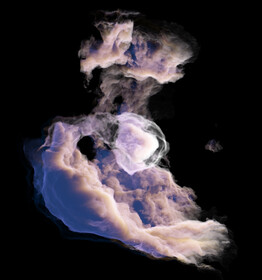
A cosmic nebula with swirls of red and white isolated on a black background. Ethereal and mesmerising beauty reminiscent of clouds in space.

A cosmic nebula with swirls of red and white isolated on a black background. Ethereal and mesmerising beauty reminiscent of clouds in space.

This work sits naturally at the boundary with astrophysics, where the same physical principles extend beyond planetary systems to more extreme cosmic environments. Investigations of planets in binary star systems, star–planet interactions and protoplanetary environments link planetary behaviour directly to stellar evolution. In this way, planetary systems are not treated as isolated objects but as parts of a continuous astrophysical landscape shaped by the stars they orbit and the environments in which they arise. 
 
The Department’s approach is defined by a close interplay between theory, simulation and observation. Physical models guide the interpretation of observational data and forecast system behaviour, while observations test and refine the underlying physics. This continual dialogue ensures that planetary research remains grounded in first principles while actively responsive to new empirical evidence.
 

Training Thinkers for a New Space Era

Education forms a central pillar of the Department’s mission. Students are trained to think in terms of fundamental physical laws, building strong foundations in mathematics, mechanics, thermodynamics and computational methods, skills essential to modern planetary science. Undergraduate students are encouraged to engage with research early, gaining hands-on experience in modelling and data analysis. Postgraduate students pursue specialised projects within active planetary science and astrophysics groups, working closely with faculty members and international collaborators.
 
“Our goal is to equip researchers and students with the tools to think deeply and rigorously about the Universe. Whether they study planetary dynamics or astrophysics, the same principles guide them: curiosity, discipline and a commitment to understanding how nature truly works,” remarked Zhang.
 
Within HKU’s broader planetary science landscape, the Department of Physics plays a  complementary and indispensable role. By focusing on the physical principles that govern planetary systems and sustaining a training pipeline defined by analytical depth, the Department advances our understanding of how planets form, evolve and interact, ensuring that HKU’s exploration of other worlds remains anchored in the fundamental laws that hold the cosmos together.
 

Probing Extreme Worlds and Cosmic Systems

Research in the Department of Physics applies fundamental physical laws to extreme astrophysical environments, extending HKU’s planetary and space science from planetary systems to high energy cosmic phenomena, such as black holes, neutron stars and dark matter. 
 
Through the close integration of theory, simulation and observation, physicists investigate how matter behaves under conditions far beyond those on Earth.

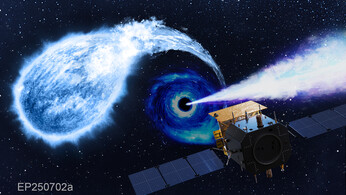
Artist's impression of the Einstein Probe satellite catching an intermediate black hole, tearing apart a white dwarf, and producing a relativistic jet. Image credit: Einstein Probe Science Center, National Astronomical Observatories, CAS / Sci Visual.

Artist's impression of the Einstein Probe satellite catching an intermediate black hole, tearing apart a white dwarf, and producing a relativistic jet. Image credit: Einstein Probe Science Center, National Astronomical Observatories, CAS / Sci Visual.

Catching a Black Hole Tearing Apart a White Dwarf
One recent example is the interpretation of an unusual high-energy transient detected in July 2025 by the China-led Einstein Probe. The space telescope recorded an exceptionally bright and rapidly varying X-ray source, EP250702a, which immediately stood out during a routine sky sur vey and triggered worldwide follow-up observations.
 
Astrophysicists from the Department collaborated closely with the Einstein Probe science team to analyse the event. By combining observational data with theoretical modelling, the team proposed that the signal may represent an intermediate-mass black hole tearing apart a white dwarf star. Key theoretical insights provided by Professors Jane DAI and Bing ZHANG were instrumental in interpreting the event's extreme energy output and rapid evolution. Their findings were published in Science Bulletin. If confirmed, the observation would provide rare evidence for a long hypothesised population of intermediate mass black holes.


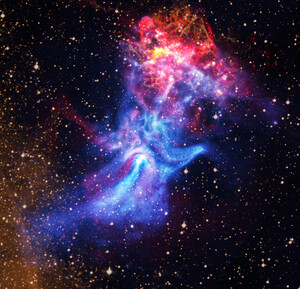
Image credit: X-ray: NASA/CXC/Univ. of Hong Kong/ S. Zhang et al.; Radio: ATNF/CSIRO/ATCA; H-alpha: UK STFC/Royal Observatory Edinburgh; Image 22 Processing: NASA/CXC/SAO/N. Wolk

Image credit: X-ray: NASA/CXC/Univ. of Hong Kong/ S. Zhang et al.; Radio: ATNF/CSIRO/ATCA; H-alpha: UK STFC/Royal Observatory Edinburgh; Image 22 Processing: NASA/CXC/SAO/N. Wolk

 Unmasking the Cosmic Hand with High-Resolution Radio Vision

In a separate study, an international team led by Professor Stephen NG used high-resolution radio observations to investigate the “Cosmic Hand” nebula, MSH 15-52, a vast structure powered by a rapidly spinning neutron star. While the nebula resembles a human hand in X-ray images, radio data revealed a markedly different morphology, dominated by fine filaments and a highly ordered magnetic field. The findings suggest that different particle populations shape the nebula at different energies and indicate an interaction between the associated supernova remnant and a dense surrounding hydrogen cloud.
 
Together, these studies highlight how physics-driven research at HKU uncovers hidden structures and extreme processes across the Universe, from brief cosmic transients to the long-term evolution of energetic astrophysical systems. The study was published in The Astrophysical Journal.


Experts in Focus

Oak Leaf Donor

Professor Bing ZHANG

Gamma-ray bursts, fast radio bursts, electromagnetic counterparts of gravitational waves, multi-messenger astrophysics

Oak Acorn Donor

Professor Jane DAI

Black hole accretion disks and jets

Oak Flower Donor

Professor Stephen NG

Neutron stars, pulsar nebulae,
supernova remnants

Oak Foundation Donor

Professor Jeremy LIM

Star formation, stellar activities,
evolved stars, external galaxies, and radio interferometry


< PreviousNext >