


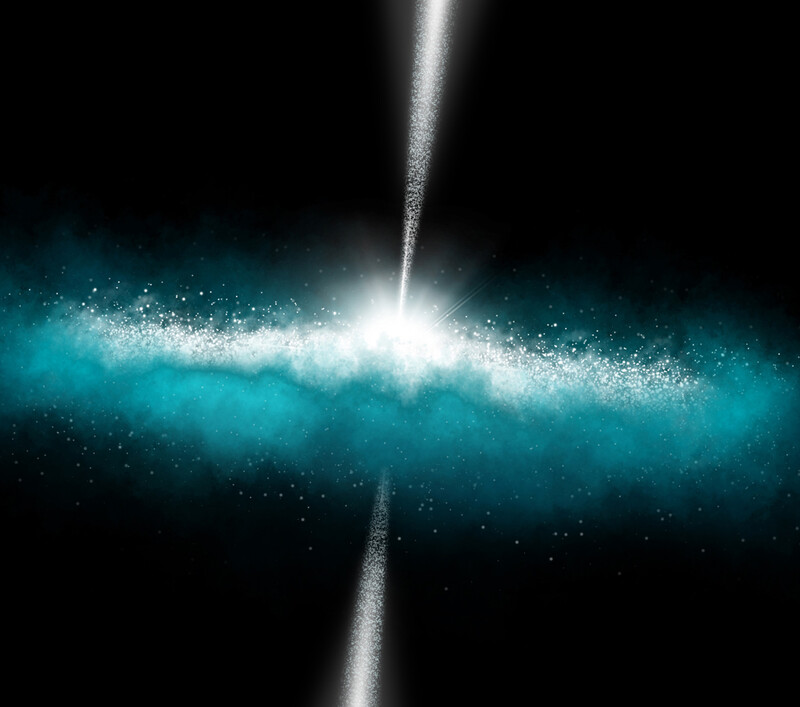
A galaxy with jets powered by a central black hole.
“A great astronomy centre is not defined by a single telescope, but by its ability to connect people, ideas and discovery across institutions, borders and generations.”
— Professor Bing ZHANG, Founding Director, Hong Kong Institute for Astronomy and Astrophysics
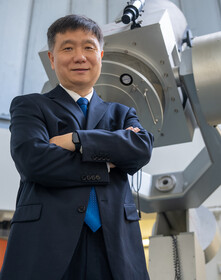
Professor Bing ZHANG, Founding Director of HKIAA.
Established in 2025 under HKU, HKIAA represents a strategic leap forward: a new research hub designed not simply to advance astrophysics and space science, but to anchor Hong Kong within the global astronomical landscape at a moment of rapid expansion and transformation.
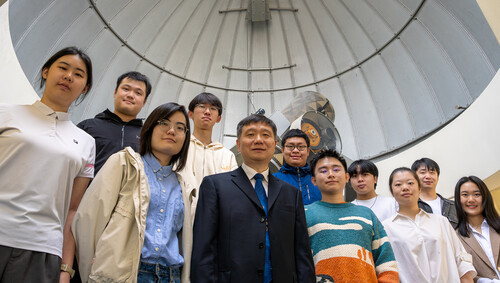 Professor Bing ZHANG and his team. |
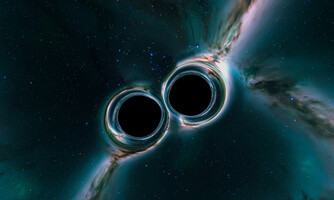
A dramatic black hole merger, illustrating gravitational waves and deep-space phenomena.
A Journey Full Circle
“Hong Kong has long enjoyed an outsized reputation in astronomy, thanks in no small part to the prestige of the Shaw Prize, the ‘Nobel of the East’,” he observes. “But our research community has historically lacked the critical mass seen in leading global hubs. That gap is precisely where growth can happen.”
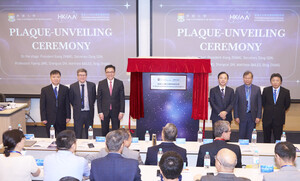
Plaque-unveiling ceremony of the Hong Kong Institute for Astronomy and Astrophysics.
“Modern astronomy is inherently a collective endeavour,” Zhang notes. “Breakthroughs now occur at the intersection of institutions and borders. HKIAA is the catalyst that makes this interaction natural and sustained.”
Through colloquia, symposia, international conferences and joint research proposals , the Institute functions as an intellectual commons where ideas circulate freely and collaboration forms a natural part of everyday practice.
A Strategic Bridge to the Stars
“Basic science thrives on transparency and openness,” Zhang remarks. “Hong Kong’s unique position allows us to bridge the international community and the Chinese scientific enterprise in a way that is both natural and credible.”
The Architecture of the Long View
“I am often approached by potential collaborators,” Zhang reflects, “but true institution-building requires the courage to be discerning.” Growth, in this view, is not a race for visibility, but a commitment to long-term scientific, institutional, and human value.
With a new physical home under development at Cyberport and continued support from the University, HKIAA is positioning itself for steady, meaningful expansion. It is an approach that favours depth over haste, and connection over scale. As Zhang summarises: “Growth is not about doing everything. It is about choosing the initiatives that will still matter twenty years from now.”
Research in Action: Translating Vision into Discovery

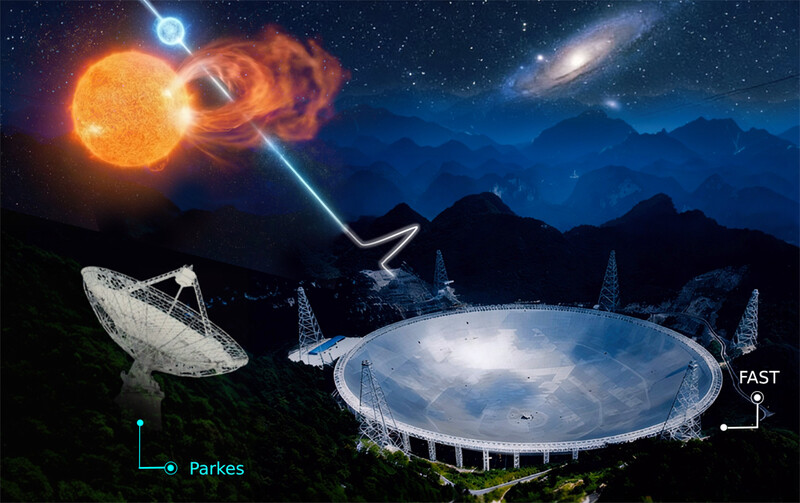
Revealing the Binary Origin of Fast Radio Bursts
Instead, the data point to a far more dynamic scenario, a magnetar locked in a binary system, its eruptions shaped by the winds and magnetic fields of a close stellar companion. This discovery, published in Science, not only provides the strongest evidence yet for a binary origin of repeating FRBs, but also propels Hong Kong researchers, including corresponding author Professor Bing Zhang, to the forefront of one of astrophysics’ most competitive frontiers.
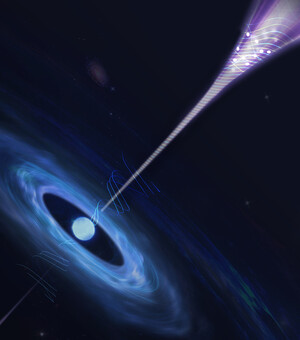
An artistic illustration of the magnetar and the gamma-ray burst jet in this work. Image credit: Yuja Tian and Yuting Wu, Nanjing Zhijiao Cloud Intelligent Technology Co., Ltd.; Scientific concept guidance: Runchao Chen and Binbin Zhang, Nanjing University.
Detecting the First “Heartbeat” of a Newborn Neutron Star
Working with partners at Nanjing University and the Institute of High Energy Physics, CAS, the team analysed data from China’s GECAM-B and GECAM-C satellites alongside NASA’s Fermi Gamma-ray Burst Monitor. Buried in the millisecond glow was a rhythmic, 909-Hz signal lasting just 160 milliseconds, the telltale pulse of a millisecond magnetar spinning nearly a thousand times per second.
Published in Nature Astronomy, this result delivers the clearest evidence yet that some GRBs are powered not by instant black hole formation, but by the brief, intense life of a magnetar newly born from stellar collapse. For Zhang, whose team proposed such a mechanism more than a decade ago, the discovery is both a scientific milestone and a narrative moment: theory coming full circle, illuminated at last by data.
| < Previous | Next > |