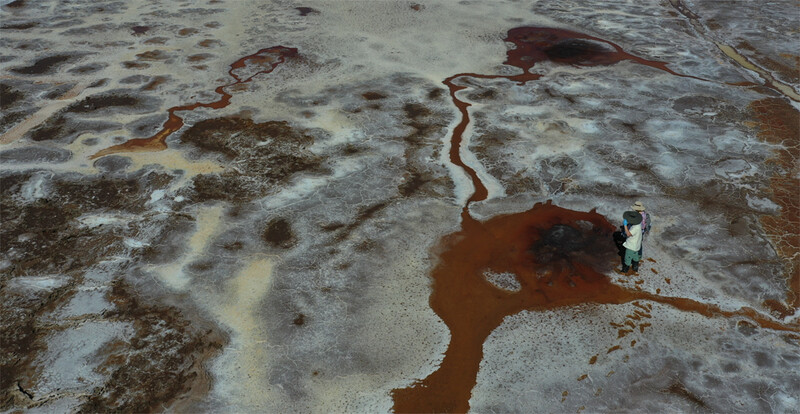
Professor Yiliang LI and his collaborators were conducting fieldwork to identify potential landing sites for the Chinese Mars Sample Return mission. Image credit: Yiliang LI
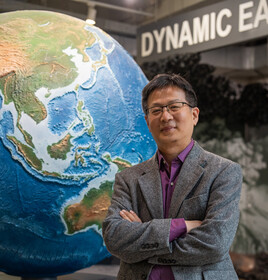
Professor Zhonghui LIU, Interim Head of the Department of Earth and Planetary Sciences.
Planetary science is often associated with spacecraft, missions and distant worlds, yet at its core it is built on Earth science. Understanding other planetary bodies begins with understanding rocks, processes and histories closer to home. This perspective has long shaped planetary science at HKU Science and is now reflected in the establishment of the Department of Earth and Planetary Sciences (DEPS).
In 2025, the former Department of Earth Sciences was formally renamed the Department of Earth and Planetary Sciences, marking the consolidation of a direction that had been developing steadily over many years. As Professor Zhonghui LIU, Interim Head of the Department, explains, “The renaming reflects what we have already become. Planetary science is no longer an addition to Earth science here—it is part of how we teach, conduct research and train our students.”
Supported by growing participation in planetary exploration programmes and international collaborations, planetary science has become embedded in the Department’s teaching, research profile and staffing. The new name recognises this evolution and places planetary science firmly within the Department’s academic identity.
Earth as the First Classroom
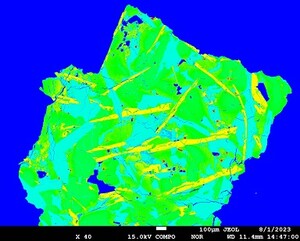
Image of the lunar sample captured by the Electron Probe Microanalyzer (EPMA) at the Department of Earth and Planetary Sciences.
The roots of DEPS lie firmly in Earth science education. Established in the mid-1990s as Hong Kong’s first formal university unit dedicated to Earth sciences, the Department was created to train geoscientists capable of addressing geological, environmental and urban challenges in a rapidly developing city. From the beginning, its curriculum emphasised strong foundations in geology, tectonics, geochemistry and Earth history.
As Earth science advanced globally, the Department’s work expanded naturally towards planetary science, including comparative studies of Earth, the Moon and Mars, and research on planetary surfaces, interiors and environments. Research on early Earth evolution and pre-plate tectonic processes provided a natural conceptual bridge to understanding other terrestrial bodies.
“Planetary science, in many ways, is Earth science extended,” Professor Liu notes. “The questions we ask about other planets are grounded in the same physical and geological principles we use to understand our own.”
Education at the Core
Education remains central to the Department’s role, with planetary science sustained through academic programmes. At the undergraduate level, the department offers degree programmes in Geology, Earth System Science and Environmental Science, including intensive tracks for professional geologists. Fieldwork, laboratory training, internships and exchange opportunities are core elements of learning.
Planetary science is integrated into this framework. Students study the Moon, Mars and planetary systems using the same scientific approaches applied to Earth, including stratigraphy, remote sensing, geophysics, geochemistry and numerical modelling.
DEPS offers research-based PhD and MPhil degrees, alongside a coursework-based Master of Science in Applied Geosciences, which focuses on the application of geology and mechanics in geotechnical practice and the development of professional skills. Building on its collaboration with Astronomy and Physics, the Department is strengthening its teaching capacity in planetary science, with new academic appointments and additional undergraduate courses underway.
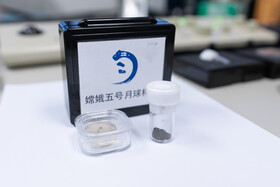
The geology team at HKU became the first
in Hong Kong to retrieve lunar samples.
Research Supporting Teaching
Teaching at DEPS is sustained by an active and increasingly planet-focused research portfolio. Research strengths span the planetary geology of the Moon and Mars, planetary dynamics and exoplanetary systems, space physics and planetary environments, planetary modelling and simulations, and astrobiology.
These activities remain closely linked to the Department’s long-standing strengths in solid Earth and Earth history, as well as global change and environmental science, and applied and urban geosciences. Together, they allow planetary questions to be examined across scales, from Earth’s early evolution to planetary surfaces and environments.
This shift is also evident in the Department’s research composition. Over time, the proportion of research activity related to planetary sciences has grown substantially, from roughly 30% to around 60%, reflecting a structural transition rather than isolated projects.
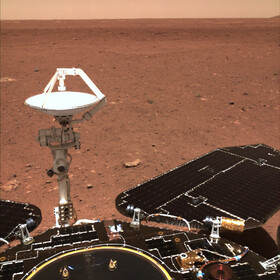
The Tianwen mission is China's national effort to explore Mars through interplanetary space missions. The rover Zhurong, depicted in the image, became China's first rover to successfully land on the Martian surface in 2021.
Image credit: CNSA
DEPS has also become a recognised contributor to planetary exploration efforts. It is the first institution in Hong Kong to acquire lunar soil samples from both the Chang’e-5 and Chang’e-6 missions. Faculty members have served on advisory committees for China’s Tianwen programme, and departmental research has contributed to Mars landing-site selection. These roles reflect sustained scientific credibility built through long-term engagement.
Within HKU’s planetary science landscape, DEPS occupies a foundational position, demonstrating how planetary science takes root most securely when it is built on first principles and sustained through education and basic research.
Earth-Based Tools, Planetary Questions
The Department’s research can be illustrated through recent studies spanning deep time, the search for life, planetary interiors and space environments, extending Earth-based methods to the exploration of other worlds.
A Planet that Shouldn’t Exist: Retrograde World Discovered in Nu Octantis

Professor Man Hoi LEE, Professor of the Department of Earth and Planetary Sciences.
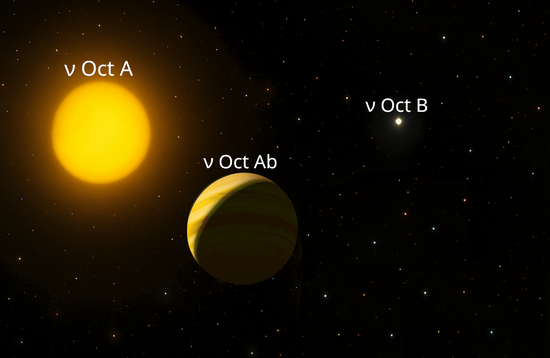
In most binary star systems, the gravitational pull of a nearby companion star is expected to disrupt planet formation or eject the planets. Yet in the n Octantis system, our astronomers have uncovered a planet that not only survives in this hostile environment, but orbits in the opposite direction to the stars themselves.
This rare retrograde orbit, long considered unlikely, has now been confirmed by a team led by Professor Man Hoi LEE. Their findings, published in Nature, resolve nearly two decades of uncertainty surrounding the system.
The binary consists of a primary subgiant star about 1.6 times the mass of the Sun and a secondary companion orbiting every 1,050 days. A periodic signal first detected in 2004 hinted at a giant planet orbiting the primary star, but its existence was heavily debated. The orbit appeared too wide to remain stable, unless the planet was moving in a retrograde direction, a configuration with no clear precedent.
To test this, the team analysed 18 years of radial velocity data, including new high-precision observations from the HARPS spectrograph at the European Southern Observatory. The results confirmed not only the planet’s existence, but also that its orbit is indeed retrograde and nearly aligned with the plane of the binary.
The study then turned to the nature of the companion star. Using the SPHERE instrument on ESO’s Very Large Telescope, the team did not detect the secondary, strong evidence that it is a faint white dwarf rather than a normal star. This implies the binary star has undergone significant evolution, with the companion shedding most of its mass before collapsing into a dense stellar remnant.
This evolutionary history reshapes the origin story of the planet. The team’s modelling shows it could not have formed alongside the stars. Instead, it may be a “second-generation” planet, either formed from material expelled by the dying companion or later captured into its unusual orbit.
Rather than a system that defies theory, n Octantis may point to a broader reality: planet formation is more flexible and more resilient than previously assumed, even in environments once thought too unstable to host planets at all.
Learn more about the research
The Moon’s Violent Birth, Revisited
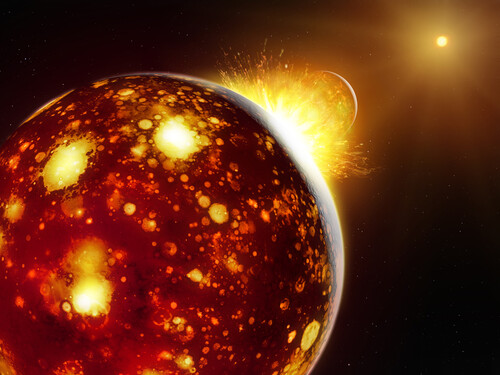
An artist’s impression of the Earth–Theia impact, with the Sun in the background, illustrating the idea that Theia originated close to the Sun.
Image credit: MPS / Mark A Garlick.

Professor Nicolas DAUPHAS, Chair Professor of Geochemistry
and Cosmochemistry.
The giant-impact theory proposes that the Moon formed when the early Earth collided with a Mars-sized body known as Theia. Although this scenario is widely accepted, a key uncertainty has persisted: did Theia originate in the distant outer Solar System or form close to Earth? A recent study led by Professor Nicolas DAUPHAS investigated this through iron isotopic signatures preserved in meteorites and lunar samples. These isotopes act as geological fingerprints, revealing where planetary building blocks formed in the early Solar System.
By analysing material returned by the Apollo, Luna and Chang’e missions, the team found that Earth and the Moon share virtually identical iron isotopic compositions, a pattern consistent with rocky matter that formed near the Sun.“Our results show that the Moon-forming impactor came from nearby. While theory allows for it to have come from afar, the measurements tell a different story. The ingredients that built our planet — and made it habitable — came from our neighbourhood,” said Nicolas Dauphas, who recently joined the Department of Earth and Planetary Sciences (DEPS) at HKU as Chair Professor of Geochemistry and Cosmochemistry.
A French-American planetary scientist and isotope geochemist, Professor Dauphas specialises in isotope cosmochemistry, using isotopic signatures to trace the origin and evolution of planetary materials. He previously spent over two decades at the University of Chicago and was elected to the National Academy of Sciences in 2024. The results suggest that Theia was not an icy visitor from afar, but a local body that developed alongside Earth. This refines the giant-impact model and implies either a shared source of material or extensive mixing during the collision. More broadly, the findings support a view of the early Solar System as relatively orderly, with terrestrial planets growing largely in place rather than through large-scale migration. The findings have already been published in Science.
Searching for Life on Mars
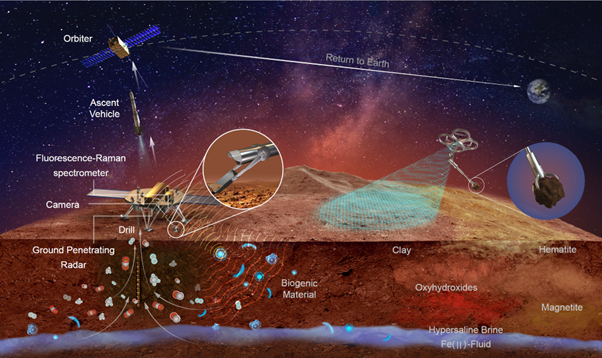
Schematic of the Chinese Mars Sample Return mission, in which the lander will drill 2 metres deep to
collect samples and scoop surface material using a robotic arm and drone.
Image credit: CNSA.
In a Nature Astronomy article, Professor Yiliang LI contributed as an astrobiology specialist to shaping the scientific framework for China’s Mars Sample Return mission, Tianwen-3. Rather than reporting a single discovery, the paper focuses on how evidence for life on Mars should be sought and evaluated with scientific rigour. The authors outline conditions most likely to preserve biosignatures, highlighting ancient environments that once hosted liquid water, essential nutrients and minerals capable of protecting organic molecules. The article also stresses the risk of false positives and proposes criteria to distinguish between biological signals and geological mimics.
Professor Li’s role centres on astrobiological assessment and sampling strategy, providing guidance on landing site priorities, drilling depth and the types of materials most suitable for return to Earth. The study further addresses planetary-protection requirements, emphasising secure handling and quarantine of returned samples and establishing a methodological foundation for testing whether Mars ever supported life.
Why Earth Is Tectonically Alive
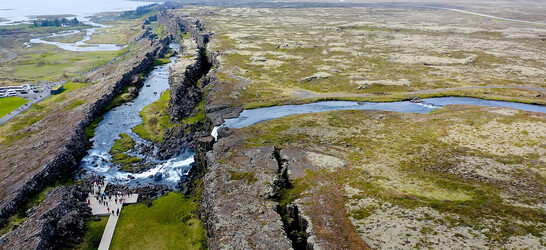
Planetary science also seeks to explain why Earth evolved so differently from its neighbours. A striking contrast lies in tectonics: Earth’s active plate system versus the largely stagnant behaviour of Mars and Venus.
In a study led by DEPS researchers, including Professor Guochun ZHAO and Man Hoi LEE, advanced numerical modelling was used to classify planetary tectonic behaviour for the first time. The team identified six regimes and discovered a new one, the “episodic-squishy lid”, characterised by alternating mobility and stability. This framework helps explain how planets transition between states and why Earth developed sustained plate tectonics. The findings have been published in the journal Nature Communications.
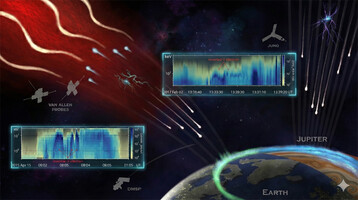
Comparative schematic of auroral acceleration processes on Earth and Jupiter. Image credit: S. Tian and Z. Yao
Powering the Auroras: A Space “Battery” Revealed
If tectonics explain how worlds evolve from within, space physics reveals how they interact with their cosmic surroundings. In a study co-led by HKU and UCLA scientists, Professor Zhonghua YAO of DEPS helped uncover the mechanism that sustains the powerful electric fields above Earth’s auroral regions. Published in Nature Communications, their findings showed that Alfvén waves, plasma waves travelling along magnetic field lines, act like a natural space battery, continuously transferring energy to charged particles and accelerating them into the atmosphere.
Analysis of satellite data confirmed that this energy persists in the auroral acceleration zone rather than fading away, resolving a long-standing question in geospace science. The results indicate that similar processes may operate on other magnetised planets, linking Earth’s auroras to the wider comparative planetary processes across magnetised worlds.
DEPS shows how planetary science can grow from strong Earth science roots. Teaching, fieldwork and laboratory work remain the core, while new missions and collaborations extend that knowledge outward. The Department’s journey reflects a simple idea: to understand other worlds, start with the one beneath our feet.
Experts in Focus |
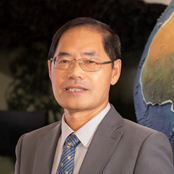
| Professor Guochun ZHAO Precambrian geology, metamorphic geology, and supercontinents in Earth’s history |

| Professor Man Hoi LEE Formation and dynamics of planetary systems
(Joint appointment with the Department of Physics) |

| Professor Yiliang LI Astrobiology |

| Professor Joseph MICHALSKI Planetary geology, mineral exploration, and astrobiology |

| Professor Zhonghua YAO Terrestrial and giant planetary space sciences |

| Professor Binzheng ZHANG Planetary and geospace environment, space plasma physics |

| Professor Jian ZHANG Precambrian geology, tectonics, planetary tectonics | | |