


Professor Celia SCHUNTER
Researchers // Professor Celia SCHUNTER, Associate Professor and Dr Arthur CHUNG, Postdoctoral Fellow,
School of Biological Sciences and the Swire Institute of Marine Science
School of Biological Sciences and the Swire Institute of Marine Science
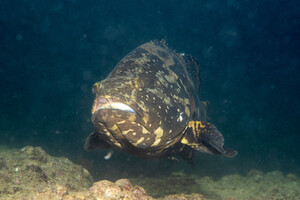
Photo credit: Arthur Chung
Our ecologists have uncovered hidden risks linked to releasing hybrid groupers into Hong Kong’s coastal waters, a practice sometimes carried out during religious mercy release rituals. The fish in question, a cross between the Tiger Grouper and the Giant Grouper, which grows quickly, reaches impressive sizes, and is widely sold in local markets. But once released into the wild, they do not simply disappear.
Using advanced DNA analysis, the research team examined what this hybrid species eats and found that it targets a wide range of prey, such as fish, crabs, and squid that native groupers rarely feed on. With no natural predators and access to underused food resources, it can easily become a dominant predator, reshaping local food webs.
The study warns that good intentions can still cause harm when non-native animals are introduced into the environment. Public awareness and better management are essential to protect Hong Kong’s marine ecosystems before the balance shifts further.
生態學家發現,宗教「放生」活動將 混種石斑魚釋放至香港沿岸水域, 可能對本地海洋生態造成嚴重風 險。研究指出,這種混種石斑在本 地海域缺乏天敵,且能捕食原本較 少被本地魚類食用的獵物,因而更 容易迅速壯大並改變食物網結構。
Journal paper: Distinct Resource Utilization by Introduced Manmade Grouper Hybrid: An Overlooked Anthropogenic Impact from a Longstanding Religious Practice (pubilshed in Reviews in Fish Biology and Fisheries, 2025)
| < Previous | Next > |