

Professor Junzhi LIU
Researchers // Professor Junzhi LIU, Associate Professor and his PhD student Jian SUN; Professor David Lee PHILLIPS; Dr Ziqi DENG of the Department of Chemistry
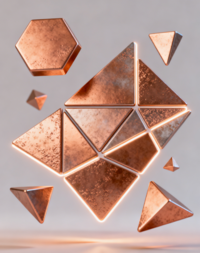 Tessellation means shapes fitting together perfectly with no gaps, like mosaics and tiled floors. In this work, our chemists achieved tessellation at the molecular scale. They designed a small,flexible carbon-based nanographene that contains three consecutive heptagons (seven-membered rings).
On its own, this molecule forms a square tessellation inside crystals. But when co-assembles with spherical fullerenes (C₆₀ and C₇₀), the pattern changes with C₆₀ it becomes triangular, and with C₇₀ it becomes rhombic (diamond-shaped).
These are the first layered tessellated frameworks ever seen in fullerene chemistry. Previously, such “supramolecular tessellation” had only been observed in much larger ring-shaped molecules.
This study demonstrates that small molecular carbons can direct the formation of complex, repeating tessellated patterns, establishing a novel design strategy for creating two-dimensional molecular materials.
鑲嵌(tessellation)指的是形狀之間能無縫緊密拼合,就像馬賽克或地磚的圖案。本研究中,我們的化學家把這種鑲嵌帶到分子層次。他們設計了一種小巧、具柔性的碳基奈米石墨烯分子,當中由三個連續的七元環(七邊形)組成。
這個分子本身在晶體裏會排成方形鑲嵌;但當它與球形的富勒烯(C₆₀ 和 C₇₀)一起組裝時,排列方式會跟着改變:1)與 C₆₀ 配對時,會形成三角形的晶格;2)與 C₇₀ 配對時,則變成菱形晶格。
這些發現是富勒烯化學中首次看到的層狀鑲嵌結構。以往類似的「超分子鑲嵌」只出現在體積較大的大環分子中。
這項研究顯示,即使是很小的碳分子,也能引導出複雜、規則的鑲嵌圖案,為設計新一代的二維分子材料帶來全新的可能性。
Journal paper: Exploring diverse supramolecular tessellation through hierarchical assemblies of nonalternant nanographene (published in The Proceedings of the National Academy of Sciences, 2024)
| < Previous | Next > |