


Professor Guochun ZHAO
Researchers // Professor Guochun ZHAO, Mok Sau-King Professor and Chair Professor; Professor Min SUN, Emeritus Professor; Dr Xiangsong WANG, Research Assistant Professor; Dr Dingyi ZHAO, at the Department of Earth and Planetary Sciences
Collaborators // Monash University, University of Washington, Yangtze University
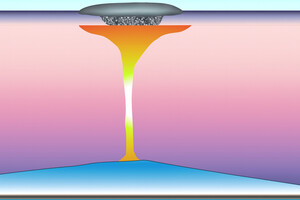 More than 2.5 billion years ago, Earth may have built its first continents not through crashing plates, but through immense heat rising from deep within the planet. A research conducted by our geologists shows that mantle plumes, towering columns of molten rock, likely played the starring role.
 The team reached this view by analysing ancient TTG (tonalite–trondhjemite–granodiorite) rocks, which act like geological time capsules. Tiny zircon crystals inside them preserve water contents and oxygen isotopes that point to extremely hot and dry formation conditions, nothing like today’s subduction zones, where plates dive beneath each other and create wet, compressed environments.
The chemical clues reveal a dramatic two-stage process: thick piles of oceanic basalt formed first, then intense heat from a later plume partially melted their lower layers to produce TTG magmas. The findings suggest that mantle plumes and sagduction, rather than plate subduction and collisions, shaped Earth’s first continents magnetic field.
地質學家揭示早期大陸地殼很可能由深層地球過程——地幔柱所形成,而非現今塑造大陸的板塊俯衝和碰撞過程。
Journal paper: A Two-stage Mantle Plume–sagduction Origin of Archean Continental Crust Revealed by Water and Oxygen Isotopes of TTGs, by Dingyi Zhao et al. (published in Science Advances, 2025.)
| < Previous | Next > |