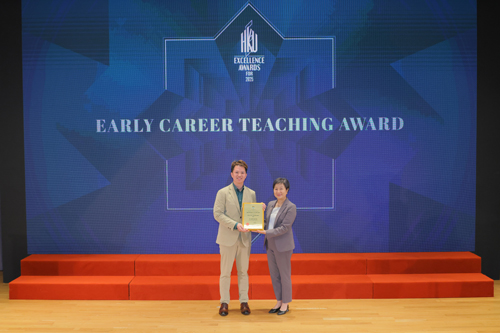
UNIVERSITY AWARD
Early Career Teaching Award 2025

Dr Kin Sum Leung
Assistant Lecturer
School of Biological Sciences
“As someone who once sat on the same laboratory benches as my students at HKU, I still remember how it felt to be unsure about what was expected in a laboratory report or why a particular mark was given. Later, when I became a PhD demonstrator, I saw the same uncertainty in my own students, especially when different demonstrators explained things in different ways. These experiences shaped my teaching philosophy: to make learning in the laboratory as clear, supportive and meaningful as possible, so that students can see themselves growing into confident food and nutrition professionals.
Whether in introductory or advanced laboratories, my first priority is to help students feel prepared rather than overwhelmed. In introductory practicals, I have developed a simple ‘laboratory pipeline’ that starts with short pre-laboratory videos, followed by focussed briefings at the beginning of each session, close coordination with demonstrators, and debriefs using example reports and marking guides. In advanced practicals, students no longer carry out isolated experiments. Instead, they follow one integrated study across several laboratories, submit weekly progress updates, and complete an oral presentation and a manuscript-style report. This structure allows them to see how their data, interpretations and writing develop over time, rather than in a single high-stakes submission.
For advanced, discussion-based courses, I also use an ‘anonymity-to-voice’ approach to help students build confidence in sharing their ideas. We begin with anonymous responses, which lowers the barrier for participation, and gradually move towards small-group and whole-class discussion. One of my happiest moments was realising that, by the end of the course, so many students wanted to contribute that I had to gently stop the discussion to move on with the slides.
The most rewarding moments in my work come from students’ reflections: comments that laboratory instructions are finally clear, that they understand how to structure a report, or that they ‘felt like real food scientists’ rather than simply following a recipe. Looking ahead, I remain dedicated to refining these learner-centred designs, exploring responsible ways to incorporate new tools such as generative AI, and sharing practical ideas with colleagues, so that laboratory learning at HKU continues to be an engaging and empowering journey for all students.”